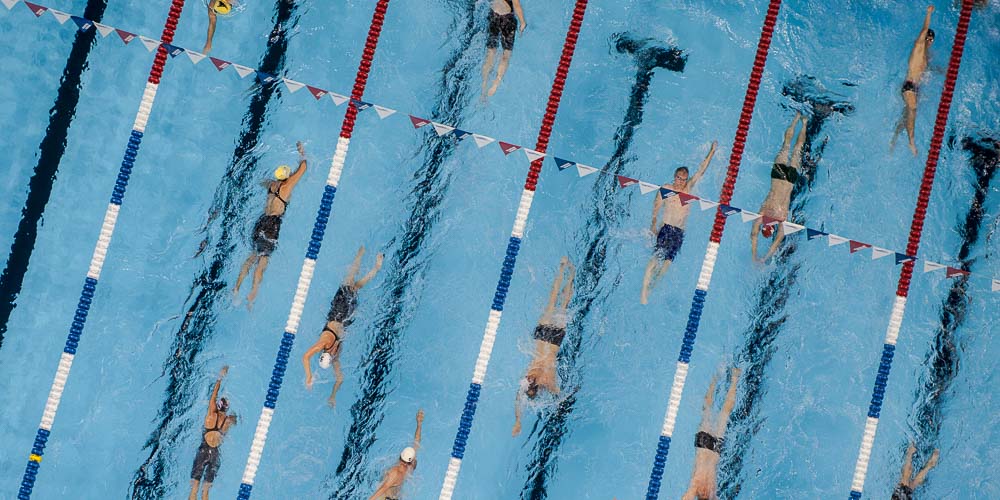
We see women closing the gap immediately in free style swimming, 50 meters to 100m, 100m to 200m, 200m to 400m, 400m to 800m, 800m to 1500m. The percentages get closer and closer as the swimming events lengthen. I was talking about this yesterday with one of my daughters' club swimming coach.
It’s the opposite in running, at 100m the differential is less than in longer events. 9.8/10.0 are basically equal to 19.6/20.0 for men, but 10.8/11.0 are much more prevalent among women than 21.6/22.0. The relative slowdown for women keeps increasing as you look at “elite” times for men and women in longer events. 30 seconds per mile over 100 meters would be 1.9 seconds and 9.5 100m for a man is so much better than 11.4 for a woman.
For swimming, it’s probably somewhat due to the start, as men get much better distance due to height/overall strength and explosiveness.
You are basically stating: the 100th fastest male sprinter is superior to the 100th fastest female sprinter. That is a long discussion. Better to just compare apex athletes versus apex athletes.
Superior strength to weight ratio helps male swimmers, 50m & 100m. The longer the swimming distance, the less valuable is brute strength. Female higher percentage of body fat help keep women on surface of water. Males are using muscles to move forward on water and using muscles to remain on water surface. Females are not working as hard to remain on surface of water compared to males.
It’s the opposite in running, at 100m the differential is less than in longer events. 9.8/10.0 are basically equal to 19.6/20.0 for men, but 10.8/11.0 are much more prevalent among women than 21.6/22.0. The relative slowdown for women keeps increasing as you look at “elite” times for men and women in longer events. 30 seconds per mile over 100 meters would be 1.9 seconds and 9.5 100m for a man is so much better than 11.4 for a woman.
For swimming, it’s probably somewhat due to the start, as men get much better distance due to height/overall strength and explosiveness.
You are basically stating: the 100th fastest male sprinter is superior to the 100th fastest female sprinter. That is a long discussion. Better to just compare apex athletes versus apex athletes.
Superior strength to weight ratio helps male swimmers, 50m & 100m. The longer the swimming distance, the less valuable is brute strength. Female higher percentage of body fat help keep women on surface of water. Males are using muscles to move forward on water and using muscles to remain on water surface. Females are not working as hard to remain on surface of water compared to males.
Recently there has been an exchange carried on within the pages of Swim Magazine that has intrigued us. Coach Terry Laughlin wrote an article for the July/August issue in which he uses some numerical examples to lend credence...
Takeaways-a 10% a power advantage in swimming will only yield about a 3 % advantage in speed. Conversely a 10% efficiency (ie drag) advantage) will yield an 11 % speed advantage.
Put simply, swimmers receive diminishing returns for increases in power while drag reductions/ form improvements offer proportional or better returns. Because elite men and women have roughly equivalent swimming technique, we see their times converging as distances increase despite differences in Vo2 Max, etc.
From the 1980 film Animalympics. For more information head here: http://www.lasertimepodcast.com/2016/08/15/animalympics-the-forgotten-animated-movie-about-a...
We see women closing the gap immediately in free style swimming, 50 meters to 100m, 100m to 200m, 200m to 400m, 400m to 800m, 800m to 1500m. The percentages get closer and closer as the swimming events lengthen. I was talking about this yesterday with one of my daughters' club swimming coach.
This makes sense in swimming, as technique is a much bigger factor than it is in running. Theoretically, there should be no difference in the potential for good technique between men and women in swimming.
Over the shorter distances, we see power having a bigger role to play, but once that is mitigated by fatigue, then technique/efficiency has a much bigger role to play.
Usually, the difference between the winners of the men's and women's divisions in major marathons hovers around 13-14 minutes. That's 780-840 seconds, which works out to approximately 19-20 seconds per kilometre.
When the gap is larger, the quality of women's field tends to be lower than the men's, and vice-versa. It's not an exact science this, but am sure there are many of you who would agree. Berlin 2022 and London 2022 were perfect examples
Usually, the difference between the winners of the men's and women's divisions in major marathons hovers around 13-14 minutes. That's 780-840 seconds, which works out to approximately 19-20 seconds per kilometre.
When the gap is larger, the quality of women's field tends to be lower than the men's, and vice-versa. It's not an exact science this, but am sure there are many of you who would agree. Berlin 2022 and London 2022 were perfect examples
But now women are as fast as some of the greatest male marathon runners in history - athletes who trained as hard as any today. Isn't it wonderful what doping can do?
But now women are as fast as some of the greatest male marathon runners in history - athletes who trained as hard as any today. Isn't it wonderful what doping can do?
I don't think that it is "only" doping. Bikila won the Rome Olympic marathon running barefoot over a course with cobbled roads. I doubt that any of the elite women today would come within 10 mins of Bikila if they had to run barefoot - even more so on a course like Rome with cobbled streets. Plus the heat of the summer. I always consider the conditions that athletes of the past were performing under .... just looking at the finishing time gives you only one aspect of the overall performance.
But now women are as fast as some of the greatest male marathon runners in history - athletes who trained as hard as any today. Isn't it wonderful what doping can do?
I don't think that it is "only" doping. Bikila won the Rome Olympic marathon running barefoot over a course with cobbled roads. I doubt that any of the elite women today would come within 10 mins of Bikila if they had to run barefoot - even more so on a course like Rome with cobbled streets. Plus the heat of the summer. I always consider the conditions that athletes of the past were performing under .... just looking at the finishing time gives you only one aspect of the overall performance.
Barefoot in Rome, Bikila beat the best of the world who all wore shoes. Women are now faster than they. (No one suggests women - or men - should run barefoot today. But as Bikila showed - it isn't necessarily the "shoes" that produce a high level of performance - it's heart, lungs and legs.) Women are also closing in on his Tokyo time and greats like Shorter. So what are they doing that enables this, when Bikila and his contemporaries and Shorter were endurance-trained athletes?
One would think it would be at a Boston or NY where there aren't rabbits. If the men ran slow one year while the women hammered, but I just created a spreadsheet comparing the men's and women's winning times in Boston and NY and there has never been a Boston or NY year where the top woman was withing 10 minutes of the top man. Not even close.
And connversely,, what's the biggest margin? My spreadsheet also shows that.
Looking at just the modern era, let's say 2000+, I think the biggest margin is Boston 2018. 23:56.
2018 needs the biggest asterisk next to it. Everyone knows it shouldn’t be part of WMM or Boston history. The slowest winning times since prize money. The largest difference between men and women. There are probably 100 things statistically that should exclude it from historical significance. 2018 Boston is the definition of an outlier.
As far as I know it is the 2003 London Marathon where Radcliffe was only 7:29 behind the men's winner Gezahegne Abera. This past week Ruth Chepngetich ran a spectacular marathon, 9:54 behind Kipruto. What are other examples where the top woman was within 10min of the top man in a world marathon major? Are there any? It really puts Radcliffe in perspective. She was so ahead of her time.
London 2003:
Gezahegne Abera Ethiopia 2:07:56
Paula Radcliffe United Kingdom 2:15:25
Chicago 2022:
Benson Kipruto Kenya 2:04:24
Ruth Chepngetich Kenya 2:14:18
Danya Crawford won the Big Cottonwood Marathon outright in 2013 in 2:46:30 beating the first man Cameron Kasteler by more than 3 minutes!
You are basically stating: the 100th fastest male sprinter is superior to the 100th fastest female sprinter. That is a long discussion. Better to just compare apex athletes versus apex athletes.
Superior strength to weight ratio helps male swimmers, 50m & 100m. The longer the swimming distance, the less valuable is brute strength. Female higher percentage of body fat help keep women on surface of water. Males are using muscles to move forward on water and using muscles to remain on water surface. Females are not working as hard to remain on surface of water compared to males.
Takeaways-a 10% a power advantage in swimming will only yield about a 3 % advantage in speed. Conversely a 10% efficiency (ie drag) advantage) will yield an 11 % speed advantage.
Put simply, swimmers receive diminishing returns for increases in power while drag reductions/ form improvements offer proportional or better returns. Because elite men and women have roughly equivalent swimming technique, we see their times converging as distances increase despite differences in Vo2 Max, etc.
We see women closing the gap immediately in free style swimming, 50 meters to 100m, 100m to 200m, 200m to 400m, 400m to 800m, 800m to 1500m. The percentages get closer and closer as the swimming events lengthen. I was talking about this yesterday with one of my daughters' club swimming coach.
It’s the opposite in running, at 100m the differential is less than in longer events. 9.8/10.0 are basically equal to 19.6/20.0 for men, but 10.8/11.0 are much more prevalent among women than 21.6/22.0. The relative slowdown for women keeps increasing as you look at “elite” times for men and women in longer events. 30 seconds per mile over 100 meters would be 1.9 seconds and 9.5 100m for a man is so much better than 11.4 for a woman.
For swimming, it’s probably somewhat due to the start, as men get much better distance due to height/overall strength and explosiveness.
I think that is partially due to the reaction time being roughly 1-2% of a 100m dash, and reaction times are the same for men and women, but as you move up in distance it becomes a completely negligable effect. So the first 0.15 seconds of a 100m is equally fast for men and women, this ever so slightly decreases the advantage as a percentage.
This effect does not occur in swimming, because their shortest distance is takes over 20 seconds to finish.
Help us build the best running shoe review site for a chance to win a LetsRun t-shirt.Help us build the best running shoe review site for a chance to win one of 10 LetsRun t-shirts.