Ruth Chepngetich’s 2:09 Marathon World Record Has Broken Our Brains
Trying to make sense of the new women's world record in the marathon
By Jonathan GaultIt was early on Wednesday afternoon, as I was watching that day’s session of the Kenyan parliament (a first for me), that I had to ask myself whether we were living in an episode of The Twilight Zone.
“I must however express my deep concern and disappointment,” said Gladys Boss Shollei, deputy speaker of the Kenyan National Assembly, “regarding the baseless allegations made by a journalist from the LetsRun.com, namely a Mr. Robert Johnson during the post-race press conference. The journalist’s reckless insinuations suggesting that Ruth Chepngetich’s world record time of 2:09:56 is too good to be true and linking it to doping without evidence and is therefore both unprofessional and disrespectful.”
After Shollei stopped speaking, a string of Kenyan politicians — 12 of them, to be exact — followed in her wake, each trying to use those “baseless allegations” (that Robert did not actually make — we’ll get to that) to score political points while supporting Kenya’s fastest female marathoner. Omboko Milemba Jeremiah (MP Emuhaya) demanded Robert retract his statement. Mayaka Irene Nyakerario went further, saying he should apologize to the country of Kenya. One MP, whose name I did not catch, called on the Kenyan government to take “proper legal action.”
 Deputy speaker Gladys Boss Shollei was one of 13 Kenyan MPs to criticize LRC for asking Chepngetich a question about doping
Have you ever watched your boss’s name dragged through the mud on the floor of a house of parliament? It is surreal.
There’s more. On Tuesday, Amby Burfoot, the 1968 Boston Marathon champion and longtime editor-in-chief at Runner’s World, had basically openly accused Chepngetich of doping without any tangible evidence. The next day, Athletics Kenya published a 400-word statement defending Chepngetich in response to a thread on X by an Irish amateur runner. The world has gone crazy — we have no idea how to live in a world in which a woman has run a 2:09 marathon.
There has never been a reaction to a world record quite like this one. Two years ago, when Tobi Amusan ran her 12.12 world record in the 100m hurdles in the semifinals of the 2022 World Championships, Michael Johnson publicly questioned the time. But Johnson’s skepticism was due to the clock itself; he did not single out Amusan, noting that most of the field ran personal bests, and did not point to doping as the cause.
There were questions about Almaz Ayana in 2016 when at the Olympics she ran 29:17.45 to smash the 10,000-meter world record (the previous record of 29:31.78, held by China’s Wang Junxia, was widely assumed to have been doped). Ayana provided the famous line “my doping is Jesus” in her defense, but because Ayana’s record had come during the first session of Olympic track & field, the following days were dominated by more races rather than a forensic examination of her time. Considering Ayana proceeded to lose the 5,000 in Rio and has been bumped down to #5 on the all-time list now that super shoes have come along, her name doesn’t generate as much suspicion these days.
Only five days have passed since Chepngetich raced at the Chicago Marathon, and the discussion around the record has been as much about the public’s reaction to the time as the time itself. Why? Chepgnetich smashed the previous record by one minute and 57 seconds, but that margin of improvement is not uncommon in the women’s marathon. Before Chepngetich, Tigst Assefa broke Brigid Kosgei‘s record by 2:11. Kosgei broke Paula Radcliffe‘s record by 1:21. Radcliffe set the record twice — she broke Catherine Ndereba‘s record by 1:29, then broke her own record by 1:53. Obviously, the faster the record gets, the harder it becomes to take huge chunks off of it. But the margin alone cannot be the reason for this hysteria.
The fact is, all of those previous world records prompted some degree of skepticism. But those doubts were largely shared in private conversations or behind anonymous handles on the LetsRun.com messageboard. Now, more than ever, they’re out in the open. Whether it is the cumulative weight of all of those previous improvements or the fact that Chepngetich hails from Kenya — a country that currently has 106 athletes suspended by the Athletics Integrity Unit for doping violations — we have reached a tipping point in the discourse.
***
How did we get here so quickly?
There was nothing to suggest that a sub-2:10 women’s marathon was a reality we would have to deal with anytime soon. Much of the running world was still grappling with the last world record from 13 months ago, when Tigst Assefa, a former 800m runner, lowered her 2:15:37 personal best (a shocking performance in itself) all the way down to 2:11:53, more than two minutes faster than any other woman had ever run to that point. Now, suddenly, Assefa is a distant second on the all-time list.
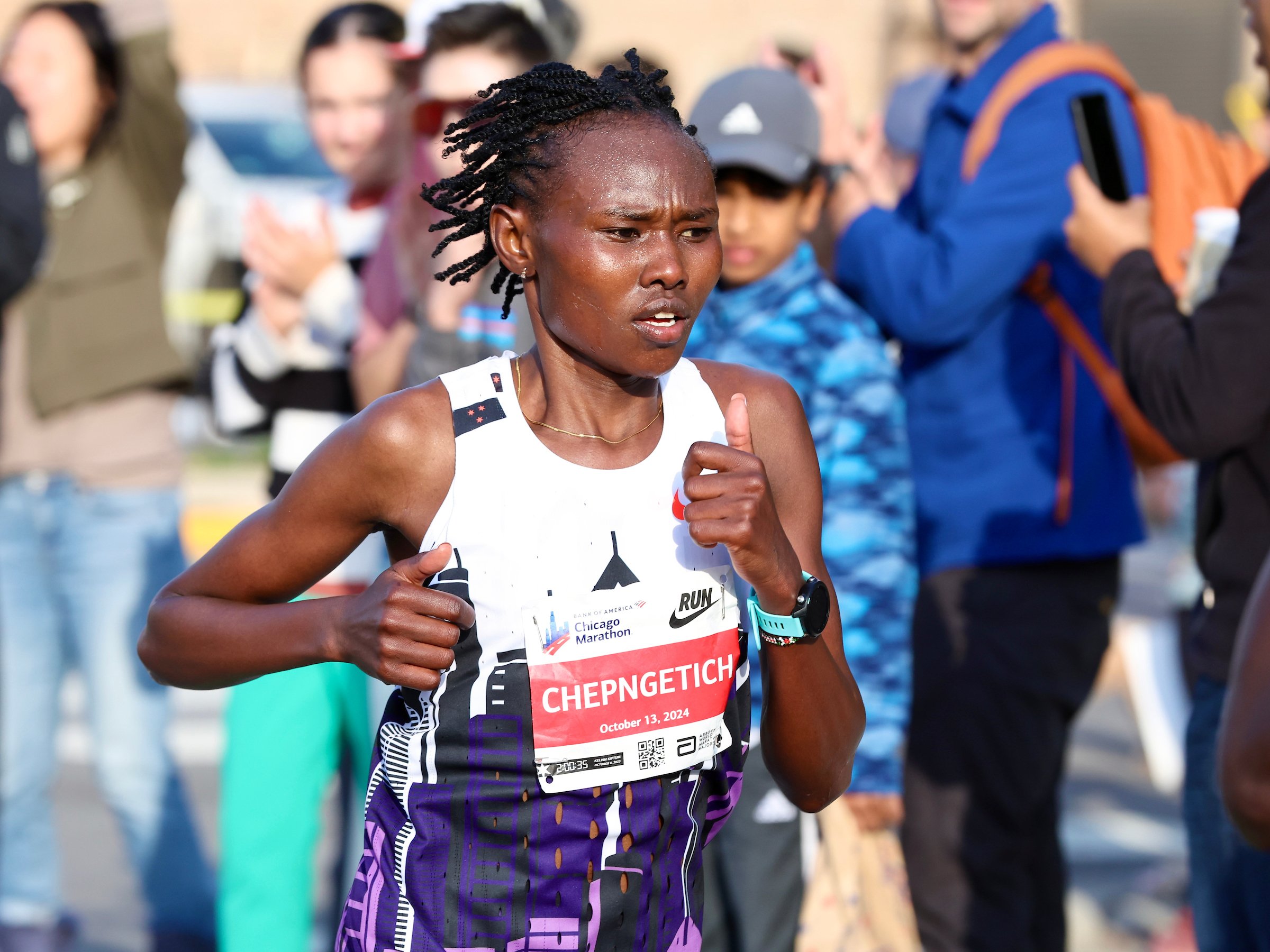 Chepngetich on her way to history in Chicago (Kevin Morris photo)
Chepngetich, one of the world’s best female marathoners for several years now, had been trying to run the world record in Chicago since 2021. In ’21, her attempt was derailed by unseasonably warm weather. In ’22 and ’23, she ran the two fastest first-half splits in history — 65:44 and 65:42 — but faded over the second half, still holding on to run 2:14:18 and 2:15:37, times that ranked #4 and #7 on the all-time list prior to this year’s race. Chepngetich had the same advantages in those races as she did on Sunday — great weather, male pacers — yet each time, sub-66:00 pace proved too hot for her.
With smarter pacing this year, 2:13 looked attainable. Maybe 2:12 on a perfect day, but nothing beyond that. Chepngetich is 30 years old, and 2024 Chicago was her 15th marathon. That deep into your career, huge leaps are uncommon: you generally are what you are as a professional marathoner. Yet on Sunday, Chepngetich took more than four minutes off her personal best and averaged 64:58 for her two halves one year after just one half at a slower pace prompted a massive slowdown. It does not make sense.
Running fans do not like it when something does not make sense. We want an explanation. Doping, of course, is the simplest, most obvious one. And those pointing fingers at Chepngetich have some ammo. The time. Kenya’s spate of recent doping cases. And then there is her agent, Federico Rosa.
Rosa has represented more high-profile Kenyans banned for doping than any other agent. A selection of his clients:
- Rita Jeptoo — 3x Boston Marathon champ, 2x Chicago Marathon champ. Banned four years for EPO in 2014.
- Jemima Sumgong — 2016 Olympic marathon champ, 2016 London Marathon champ. Banned four years for EPO in 2017 (later extended to eight for tampering).
- Lawrence Cherono — 2019 Boston & Chicago Marathon champ. Banned seven years for trimetazidine and tampering in 2024.
- Sarah Chepchirchir — 2017 Tokyo Marathon champ. Banned four years for Athlete Biological Passport violations in 2019 and eight years for testosterone in 2024.
- Titus Ekiru — 2:02:57 marathon personal best (#10 all-time). Banned 10 years for triamcinolone acetonide, pethidine, and tampering in 2023.
- Asbel Kiprop — 2008 Olympic, 3x world champ in 1500m. Banned four years for EPO in 2019.
The runners above combined to win 10 Abbott World Marathon Majors, two Olympic golds, and were banned for a total 33 years. And they do not comprise an exhaustive list.
There is no evidence Rosa is doping his clients — a Kenyan court charged him for doing just that in the wake of the Jeptoo positive in 2016, only to drop the charges. And Rosa is hardly the only agent to have one of his clients test positive. But there is a pattern here, and patterns are what you look for when you do not have a smoking gun.
Robert Johnson asked Chepngetich, fairly and appropriately, about the possibility of doping in the post-Chicago press conference. Their full exchange is below:
Johnson: “Ruth, unfortunately in recent years there’s been a number of doping positives in Kenya. What would you say to someone who says when they see 2:09:56, ‘This is too good to be true. I have questions about it’?”
Chepngetich: “I don’t have any idea.”
Johnson: “Some people may think that the time is too fast and you must be doping. What would you say to them?”
Chepngetich: “You know people must talk but…people must talk so I don’t know.”
Chepngetich appeared uncomfortable and unconvincing, but it’s hard to read much into that. Lance Armstong angrily denounced those who questioned his performances and even sued some of them and yet was proven to be a cheat. Moreover, it it is difficult to tell whether Chepngetich’s discomfort was because she had something to hide or because she was answering a question on a sensitive topic in her second language. A translator may have been helpful here.
***
Is there an explanation that does not involve doping?
If Chepngetich ran 2:09 clean, how did she do it? The main argument centers around the shoes. Nike introduced its Vaporfly in 2017 and records in distance events have tumbled across the board ever since as every brand has incorporated super foam and carbon plates into their shoes. Now, the thinking goes, athletes have been able to bank years of harder training and better recovery in the shoes, and those gains are being realized on marathon courses around the world.
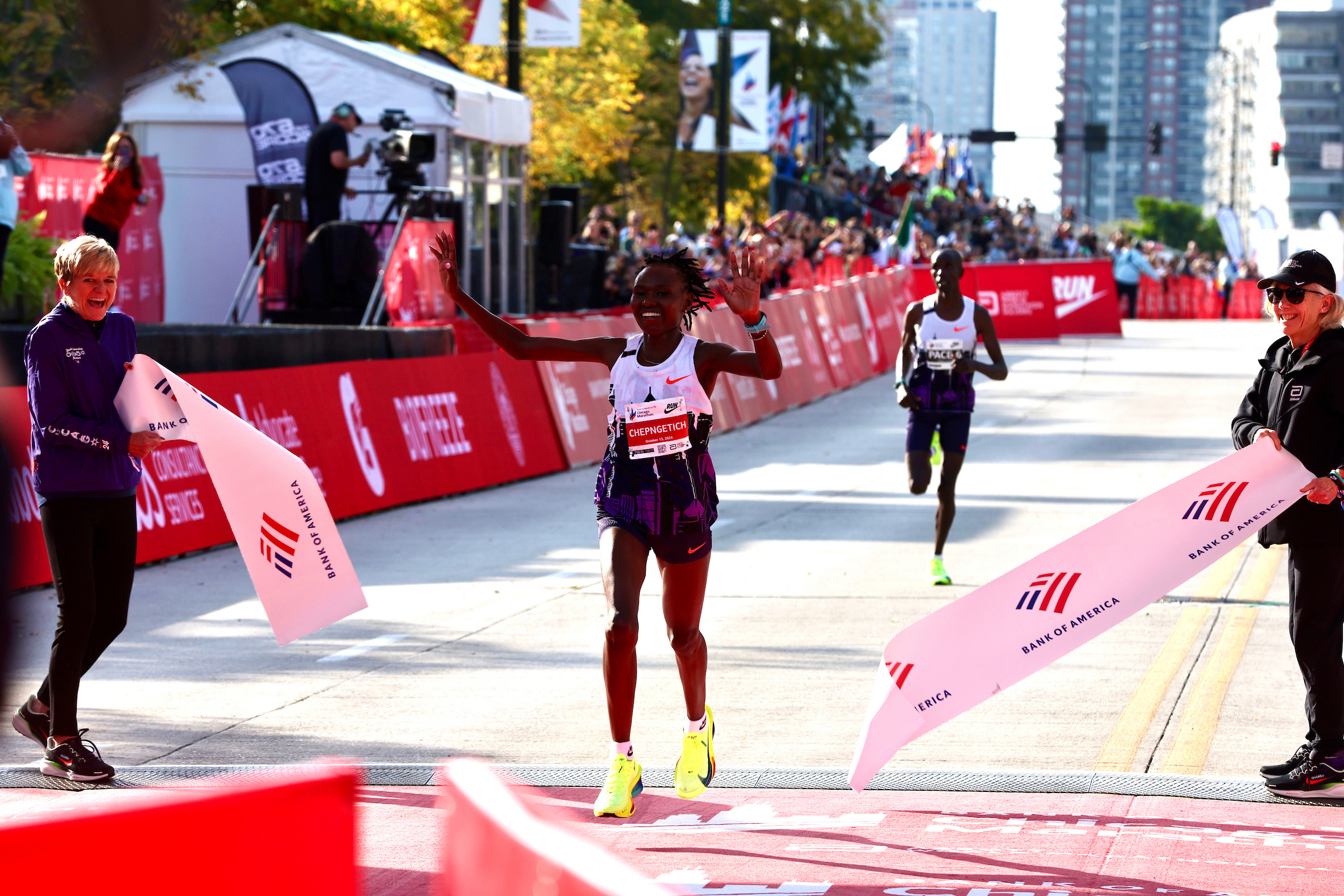 Chepngetich wore the Nike Alphafly 3s on Sunday in Chicago (Kevin Morris photo)
Okay, but Chepngetich is not the only runner who gets to use the shoes. Why is she nearly two minutes ahead of Assefa (2:11:53) and almost four minutes ahead of every other woman in history (Sifan Hassan is #3 at 2:13:44)?
One argument is that she is may only be way ahead temporarily. Assefa has run two marathons in 2024 and won neither — she was second in London in April behind Peres Jepchirchir, and second at the Olympics in August behind Hassan. Could Assefa, Hassan or Jepchirchir have run 2:10 in Chicago on Sunday? Remember Hassan ran her 2:13 in Chicago last year just six weeks after tripling in the 1500/5k/10k at Worlds. What could she do with a full marathon-specific buildup? What about reigning Boston/NYC champ Hellen Obiri, who has never run a fast course and whose coach Dathan Ritzenhein told LetsRun he thought Obiri was in 2:11 shape last fall?
Haile Eyasu, the coach of half marathon world record holder Letesenbet Gidey (62:52 pb), told LetsRun in 2022 he believes Gidey can run 2:09 one day — and that was when the world record was still 2:14.
Or maybe Chepngetich will be out on her own for years like Radcliffe was in the 2000s. Right now, we just don’t know.
It’s also possible Chepngetich is a super responder to the shoes. When Assefa broke the world record last year, we asked sports scientist Ross Tucker to help us make sense of it. He noted that studies of the super shoes have shown massive differences in running economy between athletes: one athlete may experience a 2% bump from the shoes, another might get 4%, another 6%. What if Assefa is a 6% responder and Chepngetich 7-8%?
But if that is the case for Chepngetich, we would have seen a difference by now — unless something changed. So I emailed Rosa and asked: did Chepngetich change anything for this marathon?
He said yes, two main things. First, she used Maurten’s carbohydrate mix during the race for the first time. And second, she raced in Nike’s Alphafly 3 shoe (the same shoe Kelvin Kiptum used to set the men’s world record of 2:00:35 in Chicago last year). Until this year, Chepngetich had raced marathons in the Vaporfly, but according to Rosa, “she felt much better” in the Alphafly in Chicago. (Chepngetich appeared to wear the Alphafly 3 in London earlier this year, where she finished 9th in 2:24:36, but Chepngetich told us on Sunday she was far from fully fit for that race following an injury in her buildup and basically only had a month of training).
Let’s say Chepngetich’s previous pb of 2:14:18 in the Vaporfly represented a 2% improvement in running economy. A 1% improvement in running economy is worth roughly .667% in performance, so a 2% economy gain would be worth around 1.333%. A 7% gain in economy would be worth 4.667%. Or, to put it differently: if Chepngetich’s 2:14:18 was the product of a 2% gain in economy, that same performance would be worth 2:09:45 with an 7% gain in economy.
I emailed Tucker again for his thoughts on Chepngetich. Could changing models account for such a large bump in performance?
“She doesn’t necessarily need to go from 2% [running economy improvement] to 7%,” Tucker wrote. “Even 2% to 5% might do most of it, in terms of the improvement. I think you could allow for conditions, a good day, etc to do the rest. And look, that’s still a lot. It would be significant… I’m still not sure it completely accounts for that big an improvement in someone that late in their career, at that age, but it’s certainly a possible factor.”
We don’t know how much Chepngetich benefited (if at all) by switching the Alphafly. But it’s something to consider.
MB: Ruth Chepngetich had a major form tune-up from Chicago 2023 to 2024 and it’s optimized for alphafly
***
Where do we go from here?
Even if Chepngetich is doping — and let’s be clear, there is no proof to say that she is — that does not just explain everything away.
If Chepngetich is doping, what sort of drug could possibly explain a gap of 1:56 to the next-fastest woman? Or, if you’re suspicious of Assefa as well, 3:48 to #3?
If Chepngetich has been doping for years, why did she improve so much in one race? Why hasn’t she been busted while hundreds of other Kenyans have?
And if she only started doping for this buildup, why would she even risk it? Chepngetich had already reached highest level of the sport, had already made plenty of money (she won $500,000 alone for her victories at the Nagoya Marathon in 2022 and 2023) and is still in her prime, running 2:15 just last year.
We don’t know and probably never will. Even once they are caught, athletes do not enjoy admitting to doping, let alone explaining the hows and whys.
This leaves those who follow track & field in a deeply uncomfortable situation. We’re headed down one of four paths. None of them are all that fun:
Scenario 1: Chepngetich doped but is never caught. Her record remains untouchable for years.
Scenario 2: Chepngetich’s run was legitimate and is truly the greatest female distance performance ever. Except a large chunk of running fans don’t believe in Chepngetich’s record and never will. For all intents and purposes, this is identical to Scenario 1, because there is no way for an athlete to definitively “prove” they are clean.
Scenario 3: Other women approach or even break Chepngetich’s record in the coming years and everyone struggles to apportion credit between super shoes and doping.
Scenario 4: Chepngetich is caught doping.
The last one is the only scenario that offers any sort of finality, and it would only accomplish that by invalidating one of the greatest performances in the sport’s history.
But that day may never come. For now, 2:09:56 is on the books. Believe it, embrace it, decry it, ignore it. The choice is yours. We all have to live with it.
Talk about this article on the world-famous LRC messageboard: MB: Jonathan Gault tries to make sense of Ruth Chepngetic’s 2:09:56 and reveals she recently switched from Vaporfly to Alphafly.