Faith is amazing but she's delusional as well, she could have and should have moved up to the 5000/10000m before Beatrice Chebet emerged. Now she is really regulated to the 1500m in Championship. Faith s time in the 5000/10000m is gone it's Chebet and the Italian lady's time to shine.
After watching Faith Kipyegon fail to run sub-4 mile pace for 1k in Xiamen, our Robert Johnson has penned this column:
-
019
-
Who knows what shenanigans will be going on behind the scenes leading up to the attempt? Everyyone (honest people that is) already know she’s doped to her eyeballs.
92 -
Jawan T 24 wrote:
So much hatred on here for Big Sis Faith becuz she's faster than you, prettier than you, a woman and can sit in the sun all day without the need for sunscreen. Goddess Faith just dominates the average LRCer in every way.
OK Myron, we all know that if the first sub four had been run by Norman Finkelberg you’d be up in arms over this cheat going for it. But since the first was Roger Bannister and a huge proportion of thoae that followed were eh, “citizens of Edom” as you clowns would claim, it’s OK to use cheating Africans as a battering ram.
50 -
Sus beyond words wrote:
Forget the micro dosing and whatever else she’s on. She needs to pull out the IV bag for this one. WADA pay attention. And while your at it keep a closer eye on Obiri
Even going full throttle won't be enough to make Kipyegon go sub 4
30 -
eagleeye wrote:
-New shoe tech (Nike probably has their own Puma up their sleeve)
-New fueling tech (bicarb, etc)
-Maybe new track tech (do they have something like Feldspar in mind?)
-Likely rotating cast of male pacers
-Wavelight techThis is going to be way closer than a lot of male letsrunners will be comfortable admitting to themselves. I'll put the odds on 4:01.x at 80% with a slight fade in the final 150 that keeps the dream alive.
Enabler
05 -
That’s a pretty big jump to go from 4:07 to sub 4.
but if any woman could do that it would be her.
55 -
ObserverofTrends wrote:
😆 you are correct about all that!
but the problem is Kipyegons current WR at 4:07 is already five seconds faster than the #2 alltime (Hassan). A major improvement ln her own WR would establish her as performance-wise the most dominant athlete in history in a running event. e.g. a 4:04 would position her 8 seconds or 3.4 percent clear of all other athletes in history.
For Jakob to gap his competitors comparably in mens mile hed have to run a 3:37.
For M400 that would be a 41.6
For W LJ that would need 7.80
For the FloJo 100 that would need a 10.13
Even Mondo who is regarded as historically dominant would need to clear 6.47 to gap Lavillenie/Bubka similarly.
So...how is this supposed to happen?
You went through all that trouble instead of just looking at how her superior 1500m compares to her competitors, instead of an obviously faulty premise.
23 -
VIPAM wrote:
Faith is amazing but she's delusional as well, she could have and should have moved up to the 5000/10000m before Beatrice Chebet emerged. Now she is really regulated to the 1500m in Championship. Faith s time in the 5000/10000m is gone it's Chebet and the Italian lady's time to shine.
The 10,000 has one prominent track race a year and a scattered number of low-buzz 10Ks mostly on the roads. Why go to that? The 5,000 move timing was fine, and outside of that it’s simply a question of when she tries a marathon. 2026 likely.
10 -
A certain sensitive old mod is deleting harmless posts that put this accomplishment in perspective if she succeeds. Yes, m-lmo with his 4:00.5 PB would be chicked.
11 -
after a 2.01 half mile, it's over
00 -
rojo wrote:
Mocazilla wrote:
IS this on the track? On the road? Male pacers? Legal shoes? I assume this won't be a öfficial WR"like breaking 2
Nike's press release says they will run it in the same stadium where the Paris DL is so it's on the track.
The press release doesn't say but of course they are going to have male pacers (or I guess they could have women pacers jumping in and out but it seems easier to just use men the whole time).
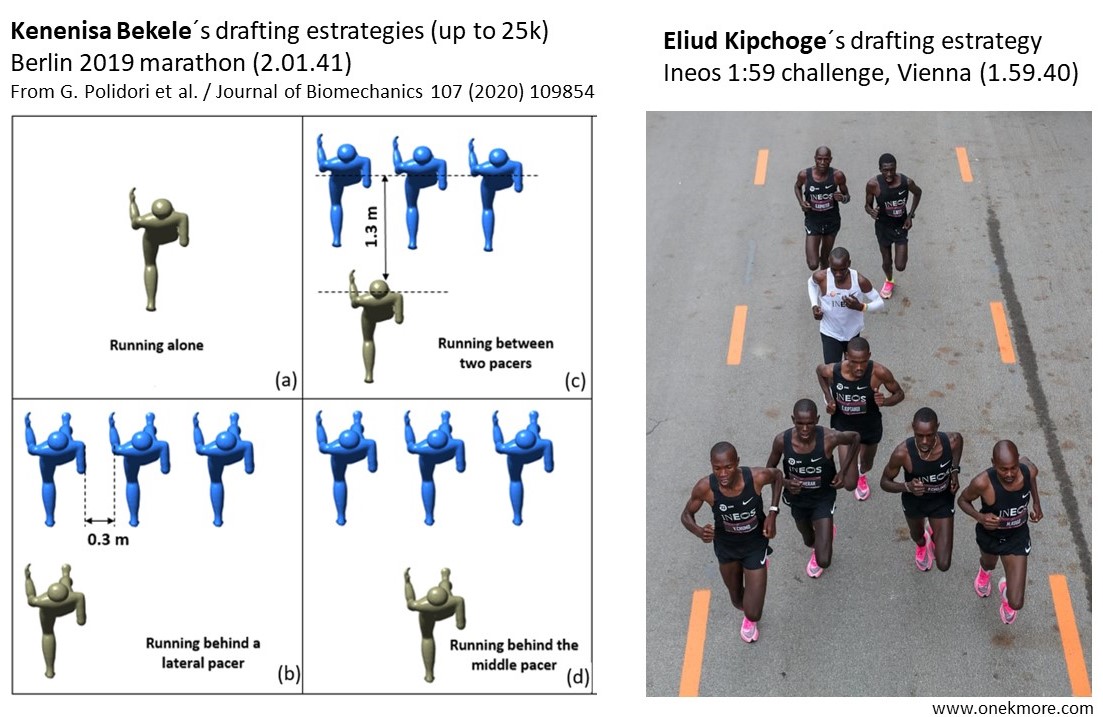
I'm assuming they'll use a v formation and have the pacers in front and back of her. So I'm wondering if maybe she'll run out in lane 5 or something or if they'll have half of them run on the inside of lane 1.
When she ran her 1500 WR, she had good pacing for 2:11. Here she'll get it the whole way. So let's subtract 2 more seconds for extra 800 pacing and then an extra second for V formation. Hell make it two. So let's give her 4 more seconds for the V formation the whole way.
That's 4:03. She's still a long way from sub-4.
I don't think Faith is remotel fast enough to break 4:00. To break 4:00, you need to be alike a 1:53 800 runner at the worst.
Is he V formation in the back the same as in the front? In the front, the way they did it for Kipchoge was not like an icebreaker but like cupping the air and pushing it forward. Would the formation in the back be the same? Your idea of doing the whole thing in lane 5 is interesting. Or they could do it at Franklin Field! (on my mind since I am running masters relays there tomorrow)
02 -
rappatic wrote:
To be held on June 26th in Paris.I’m a huge fan of Faith’s but there is absolutely no way this works. Perfect pacing and drafting don’t let you drop over 7 seconds from your world record PR. I’m predicting 4:03.9.
I can see it now 59.9, 59.9 59.9 69.9...hit the wall
20 -
Bonnie Blue Flag wrote:
That’s a pretty big jump to go from 4:07 to sub 4.
but if any woman could do that it would be her.
Correct. Because non dopers would never achieve a sub 4
40 -
Pacesetter through 800m Shelby Houlihan
40 -
Jawan T 24 wrote:
So much hatred on here for Big Sis Faith becuz she's faster than you, prettier than you, a woman and can sit in the sun all day without the need for sunscreen. Goddess Faith just dominates the average LRCer in every way.
Stop smoking that crap. You sound delusional
21 -
Exactly right wrote:
Bonnie Blue Flag wrote:
That’s a pretty big jump to go from 4:07 to sub 4.
but if any woman could do that it would be her.
Correct. Because non dopers would never achieve a sub 4
I heard her track spike prototype are rocket propelled. She probably will run 3:55 LOL
00 -
rappatic wrote:
To be held on June 26th in Paris.I’m a huge fan of Faith’s but there is absolutely no way this works. Perfect pacing and drafting don’t let you drop over 7 seconds from your world record PR. I’m predicting 4:03.9.
Did u hear its in Paris on the huge downhill mile of the marathon course. I say she runs 3:42.99
10 -
rojo wrote:
Two thoughts . The first that jumped into my head was:
1) Is today April 1st?
Then after a few minutes of thought and a text from weldon:
2) Nike wouldn’t do this to totally embarrass her so they must have something up their sleeve. How ridiculous are the shoes going to be?
I thought the same thing ROJO. I thought this sounds like a letsrun April Fools Day homepage. Guarantee the shoes will be something that will aide so much they would never be allowed in a legitimate race
10 -
The same lab involved in Kipchoge's calculations for the sub-2 hour marathon did the calculations for Faith going sub-4. The calculations showed theoretically it *might* be possible under the perfect conditions. She was 3% off the 4-minute mark, which was how far the men were from the 2-hr mark.
For the new study, the team pored over video of Kipyegon’s record one-mile finish
in Monaco. The wind was dead calm. A slight humidity (which reduces air resistance) hung in the air, and she was wearing state-of-the-art shoes.But her pacers ran too fast at first, said Kram, letting the gap between them and her widen. By the last lap, her pacers had dropped out and she was on her own.
Ideally, he said, one female pacer would be perfectly spaced in front, another in back, for the first half mile; then another fresh-legged pair would step in to take their place at the half-mile point. Collectively, previous research suggests, they could cut air resistance by 76%. Using that value, the team calculated her projected finish time: Remarkably,
3:59.37—the same time Bannister hit in 1954. “We didn’t cook these numbers,” joked Kram. “We saw that and just smiled.”
Kipp, now a postdoctoral researcher at the Mayo Clinic, stresses that their study, like most in the field of exercise physiology, comes with a caveat: Their calculations were based on previous studies that exclusively involved men. The authors hope their paper will help spark more interest in studying the physiology of female athletes.25 -
Sarazam wrote:
Maybe it is intuitively incorrect, but many of the changes for the Sub2 record seem far more beneficial for a marathon distance than a mile. Most marathon records are set with the runner breaking away from the pack pretty soon into the marathon, running solo the majority of the race. Adding in pacers for the entire race is a huge wind break benefit + mental benefit. Completely flat course also helped a ton. No sharp turns. Perfectly timed nutrition/water/electrolytes. Ability to modify the day they actually have the race. If Kipchoge woke up feeling a little off, or was nervous the night before and slept an hour too little, they could just move it to the next day. There's a reason that many many marathons will have elite guys DNF or run far slower than their normal, the little things are super important.
What are they gonna do for the mile aside from new shoe technology? They already had pacers for the first 1000m, is she going to be able to run 7 seconds faster with pacers on the last lap?
I 100% agree, there were so many more factors in that scenario than at play here - and especially with the original attempt in the OG 4% shoe.
It was the first time they used that shoe with that tech in a publicized event and this shoe was dramatically different from previous product used. This will not be at play here - the chatter around crazy cheater spikes - what exactly are they envisaging here? 60mm stack height spikes with CO2 canisters on them? The current "cheater spikes" everyone is up in arms about have really one difference and one difference only from product of the last 30 years and that is super critical pebax/TPE based foams at approximately twice the thickness of the past. It's really not that crazy.
Back to the first Breaking2, it was also the first time they really dialed in on the importance of completely even paced running - right from the first 100m. It was wavelight before wavelight - the pace car with the pace line. Well that also exists now and has been really successfully utilized in every distance WR set in the last 4 years starting with Cheptegei and the absurdly even lap/km splits of his 5 and 10 records and also with Kipyegon in her 15/mile and 5km records.
All those other things you mentioned - totally flat course which is basically impossible in a regular Marathon, well they won't be getting any benefit of improving that here either as she and everyone only ever runs on flat tracks outdoors. There were so many more smaller but important elements they could tweak in that attempt, along with the more obvious ones like footwear, pacing and drafting (over 42195m it's surely a far bigger deal than over 1609m) - to suggest this can be done only with aerodynamic drafting when the 2-3% they gained in the marathon was achieved by improving a myriad of elements - I just don't get the claim.
This post was edited 51 seconds after it was posted.31

What People Are Talking About On LetsRun
No top threads at the moment. Check back soon.