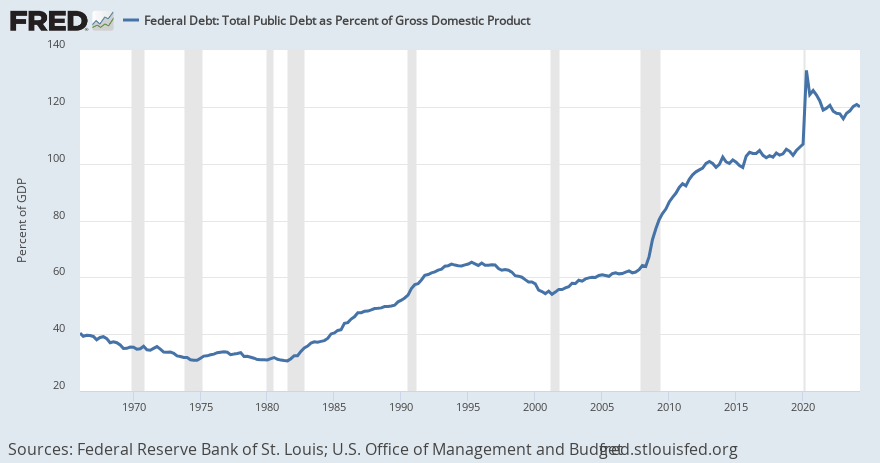
no doubt we need to spend less, but viewed as a percent of GDP, a bit less scary.
If I had to pick one good thing about the economic possibilities from the new admin is that maybe they will cut some federal spending. I mean that's a maybe. But at least they are talking about it and not getting too much blowback.
The GDP is rising with more deficit spending. When you dig deeper the incremental increases in Government spending buys a smaller unit of GDP. The Igy Lemonade Stand analogy holds that mommy and daddy are supplying the product and “hiring” the labor. To objectively ignore the stupidity is beyond me.
And mommy and daddy are the American taxpayer, trading up for inflation. There has already been consequences for the madness. To believe it is a zero sum game would be foolish. There are observable reasons for extended stock valuations, many asset are higher for some of the same reason groceries are higher.
This post was edited 4 minutes after it was posted.
Eventually (when?) we will have a down market for a calendar year. The last 2 have been good, so a bad or mediocre one is going to happen to even things out. Historically, first year US Presidents mean a lowish market with Republicans faring worse than Democrats.
BUT, you likely know that I don't care, and neither should any of you. If you're working, invest anyway. If you have debt, get rid of it. If you are in retirement and the market is bad, use SS and liquid savings that aren't in the stock market to pay bills, or if you are comfortable or loaded, then just take as you would from your stocks anyway, or take a smaller percentage out if you want. Not rocket surgery.
If you go back about 80 years, the S & P, outside of 2000-2002, has only had consecutive down years once - 1973 and 1974 - followed by a monster 1975. In fact, almost every down year has been followed by a monster year. And there has been only about 12 years, ignoring 2000-2002, since 1947. So about 80 years.
Well, that would make sense since the market goes up ~73% of calendar years and the trend is UP. There is just no reason to mess around with trying to time the market. Average American income earners today can make enough in the stock market, investing in diversified mutual funds, to set their decendents up for life (as long as those in the lineage continue to invest as they should and don't squander the fortune).
If you go back about 80 years, the S & P, outside of 2000-2002, has only had consecutive down years once - 1973 and 1974 - followed by a monster 1975. In fact, almost every down year has been followed by a monster year. And there has been only about 12 years, ignoring 2000-2002, since 1947. So about 80 years.
Well, that would make sense since the market goes up ~73% of calendar years and the trend is UP. There is just no reason to mess around with trying to time the market. Average American income earners today can make enough in the stock market, investing in diversified mutual funds, to set their decendents up for life (as long as those in the lineage continue to invest as they should and don't squander the fortune).
I think this view about financial solvency and generational wealth may be true for some, but does not represent a major portion of Americans, and I think it is unfair to pretend that it does.
If I had to pick one good thing about the economic possibilities from the new admin is that maybe they will cut some federal spending.
1) The new administration has promised to greatly cut spending. Knowing that it is Trump, my first inclination is to not believe that because he's a serial liar who hasn't done the vast majority of what he has said he would do, BUT, since he has Elon Musk in the fold, I expect it likely will happen and that it will be done in about the most disasterous way possible.
2) The rounding up of immigrants will be a big issue if in fact Trump does this in the manner he has suggested. I expect mistakes, (like people sent away who are actually citizens), and unnecessary human suffering as a result of this amoral, uncaring President Elect. Ironic too, of course, because Trump has hired scores of illegal immigrants over the years.
3) All of the Dreamers should be given a path to citizenship if they so desire. Not their fault that a parent brought them here illegally when they were children. America needs them...we need them to help fill the 11 million jobs that are currently unfilled (and no, they are not all and not even mostly, jobs that Americans don't want). We want their tax revenue. I, personally, want access to their culture, their food, their insight.
Well, that would make sense since the market goes up ~73% of calendar years and the trend is UP. There is just no reason to mess around with trying to time the market. Average American income earners today can make enough in the stock market, investing in diversified mutual funds, to set their decendents up for life (as long as those in the lineage continue to invest as they should and don't squander the fortune).
I think this view about financial solvency and generational wealth may be true for some, but does not represent a major portion of Americans, and I think it is unfair to pretend that it does.
Creating generational wealth is absolutely possible for most Americans...they just choose not to do it. Yes poverty is real. Yes, many people struggle. Nearly 40% of Americans have college degrees. Every single one of them sans a disability of some sort absolutely should be able to retire with many millions of dollars, which, when passed down, should turn into tens of millions and then on up from there. When you add in all of the people who make good incomes without a degree, it's way over 50% of Americans who have the ability to invest to become wealthy.
But, people want gas guzzling trucks and 4 wheelers and fishing boats and big houses and expensive cars and they don't budget their food bill and they eat out a lot, and on and on.
It's easy to become rich in America...people just choose not to.
I think this view about financial solvency and generational wealth may be true for some, but does not represent a major portion of Americans, and I think it is unfair to pretend that it does.
Creating generational wealth is absolutely possible for most Americans...they just choose not to do it. Yes poverty is real. Yes, many people struggle. Nearly 40% of Americans have college degrees. Every single one of them sans a disability of some sort absolutely should be able to retire with many millions of dollars, which, when passed down, should turn into tens of millions and then on up from there. When you add in all of the people who make good incomes without a degree, it's way over 50% of Americans who have the ability to invest to become wealthy.
But, people want gas guzzling trucks and 4 wheelers and fishing boats and big houses and expensive cars and they don't budget their food bill and they eat out a lot, and on and on.
It's easy to become rich in America...people just choose not to.
I told the story of my grandfather a few weeks ago...born poor in europe around 1903, no education, never made much of a salary but he put money in the stock market from an early age and waited. Died a millionaire in the 1980s.
It absolutely can be done but Americans are not good savers. Any family that has been here for 50+ years should be quite wealthy by now (unless they had a serious setback)
BREAKING: President-Elect Donald Trump announces Elon Musk and Vivek Ramaswamy will lead the Department of Government Efficiency (D.O.G.E.) pic.twitter.com/zYtr6qZjeJ
interesting thing is that the very high valuation is because of the tech giants. Take them out and the average SP500 stock has a totally normal PE of 17.
I have moved some money from the regular SP500 to the unweighted SP500...I lose some of that tech octane and quality but I get the best companies in the world in a surging economy for a normal valuation. Seems pretty good.
interesting thing is that the very high valuation is because of the tech giants. Take them out and the average SP500 stock has a totally normal PE of 17.
I have moved some money from the regular SP500 to the unweighted SP500...I lose some of that tech octane and quality but I get the best companies in the world in a surging economy for a normal valuation. Seems pretty good.
Creating generational wealth is absolutely possible for most Americans...they just choose not to do it. Yes poverty is real. Yes, many people struggle. Nearly 40% of Americans have college degrees. Every single one of them sans a disability of some sort absolutely should be able to retire with many millions of dollars, which, when passed down, should turn into tens of millions and then on up from there. When you add in all of the people who make good incomes without a degree, it's way over 50% of Americans who have the ability to invest to become wealthy.
But, people want gas guzzling trucks and 4 wheelers and fishing boats and big houses and expensive cars and they don't budget their food bill and they eat out a lot, and on and on.
It's easy to become rich in America...people just choose not to.
I told the story of my grandfather a few weeks ago...born poor in europe around 1903, no education, never made much of a salary but he put money in the stock market from an early age and waited. Died a millionaire in the 1980s.
It absolutely can be done but Americans are not good savers. Any family that has been here for 50+ years should be quite wealthy by now (unless they had a serious setback)
My in-laws are similar. While I have no idea how much money they have, I DO know that they inherited $300,000 15 years ago (that they immediately invested) AND aside from that, they have been big investors in the stock market since they were in their early 20s. I know that they paid off their first house in 7 years and then have not had a mortgage of any kind for their future houses. They haven't had any debt of any kind since they paid off that first house, and they just don't spend money on anything pretty much ever. He was a middle manager at a big company for most of his working life, and she was a secretary. They never made big income, but I suspect they are sitting on as much as $10 million, and if it's less than ~$6 million, I will be surprised. I learned my saving and investing and paying off debt ways from them, but they are way more extreme than I have ever been. They don't turn lights on in their house unless they are up when it is pitch black dark outside. They now have just one car, and it's a Hyundai. They took annual vacations to The Outer Banks for about as cheaply as you could get. Anyway, they aren't the Millionaires Next Door. They are the Multi-Millionaires Next Door.