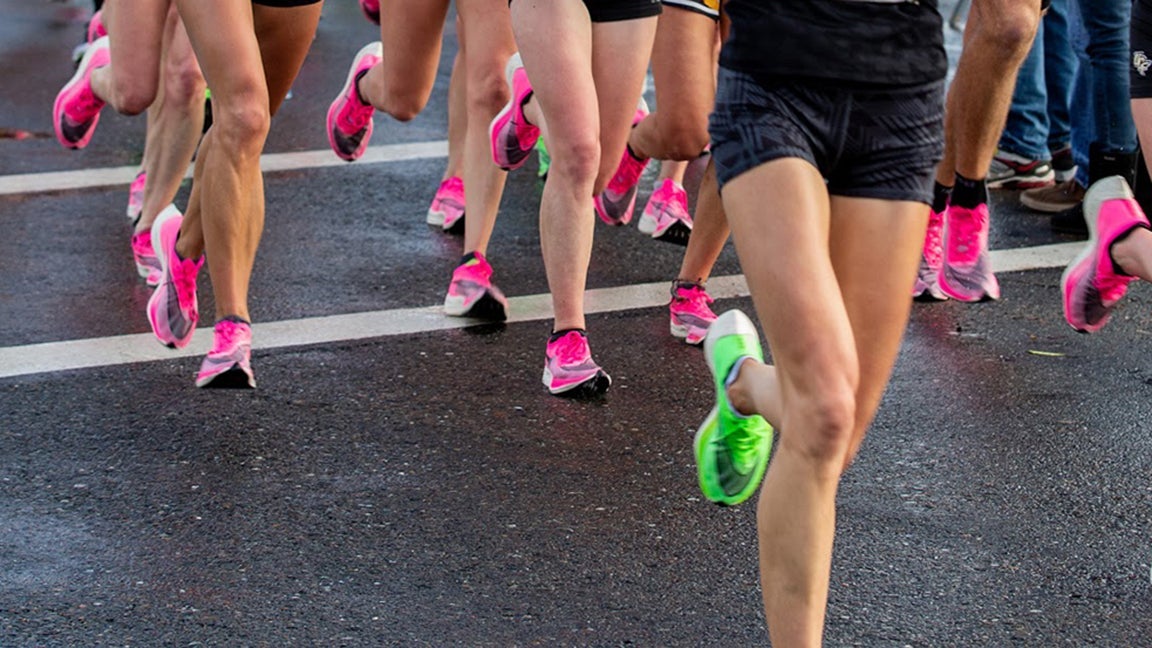
LRC note: We've merged two threads on the topic into 1 and combined the thread titles. The quote comes from this article: https://www.letsrun.com/news/2...
I'm repelled by your morally loose attitudes towards 'the shoes will stay' statement and 'time to move on and man up'. That's your typical childish, kiddish or imprudent defiance or recalcitrance, I see through your heart and mind this way! It's people like you who usually get into trouble with authority or take uninformed risks just because 'you only live once' or YOLO!
I however am very unlike you, I'm far more matured and circumspect in my views, morally well-balanced and insightful as well in all humility and honesty and I will make these findings for everyone:
1) Ross Tucker is the darling of our sport and I have huge respect for him; I may even smooch him if he actually outright said Kipchoge especially were a doping fraud and El G not one.
2) Ross Tucker makes very good, useful and insightful points about these immoral shoes and shoe technology; I have never seen another sports scientist do a better job than him. Geoff Burns is also quite good but I'm surprised he gives more conservative margins of improvement for the shoes than Ross.
3) I think Ross is probably right, and more right than Geoff as Ross gives a range of uncertainty for the shoes on both sides of zero point, which does make lots of sense. The shoe needs to have non-responder and responder just as the COVID vaccine needs to have responder and non-responder as well. You need pros and cons, hence a bell curve to constitute any truth in the universe. That's a universal truth/law in and of itself!
Weaknesses of Ross:
1) He keeps preoccupying himself all day with every other correlation and affiliation of sports science from shoes, drugs, gender/genes, temperature/weather, psychology, sociology and what else except anthropogenic RF (radiofrequency). Does he not think that anthropogenic RF could throw off and distort all his ranges and margins as easily as the tipping of a North pole of a magnet to the south of another? Come on Ross, as an RF engineer and expert myself, you really don't know much or haven't seen the true meaning of the term 'CAUSE' until you migrate out of all these superficial pursuits of science such as shoes and the like to the realm of RF. RF is a realm of science that takes no prisoners, and its answers are as dynamically transforming and mutating in space and time as the fickle weather. RF science will torment and torture even the most mentally and emotionally resilient scientist and break him/her down into despair and exhaustion.
2) He doesn't commit himself enough. He keeps saying things like:
"So this is where we are – too many moving targets, too many degrees of freedom, too many unanswerable questions. Only principles, broad ranges, but overlapping ranges, such that we can’t attribute a given portion of the improvement to each of the possible components that created it."
Too many moving targets, too many degrees of freedom, too many unanswerable questions, only principles, broad ranges, overlapping ranges etc. Then I would ask Ross straight in the face if he should just migrate to realm of science in RF instead and start studying and researching the effects of anthropogenic RF on human high-performance and how whether it's more significant or less significant factor than the super shoes? The realm of RF science has far more moving targets, degrees of freedoms, unanswerable questions, broader principles, broader ranges and overlapping ranges too I can wager easily.
My dissatisfaction towards Ross would be also: what if the effects of anthropogenic RF were even double or triple the effects of the supershoes in the women's marathon WR? Would Assefa be running 2:06 then if she were running in an ancestral environment devoid of anthropogenic RF since it would make a mockery of all these inconsequential and non-factor research and study of how supershoes advance athletic high-performance if it only could provide a mere 2+min improvement to the women's marathon WR while the RF one could provide 8minutes?
However I would say that my dissatisfaction is something very unique among mainstream messageboarders and scientists so I wouldn't ordinarily expect to be continually dissatisfied if my current temporal dissatisfaction couldn't be relieved due to lack of expertise on here in this arena. :P
This post was edited 5 minutes after it was posted.
I interviewed the scientist who first studied the first Nike supershoes that were called the 4%. You know why Nike called them the 4%? Because the study found that the range of assistance that the shoes bring is 2% to 6%, 4% is half way in between. Seems arbitrary, but the point is about the even playing field. A person who is slower, than another but benefits more from the same shoe is getting an unfair advantage.
That is a major issue.
But variations in response exist with shoes other than supershoes, depending on personal reaction to stack heights and various foam densities. Not all non-supershoes run the same, and not all supershoes run the same. Make your choice and lace up.
Yeah, the key part of that quote is the very first line: "I hate these shoes." Tucker hates the shoes, so he looks for any argument to criticize them.
There's absolutely massive individual variation in, say, response to altitude training. There's massive individual variation in how different runners respond to different surfaces. So it's not clear why individual variation in shoe response should be such a big deal.
Yes, he is starting think like a layman instead of a scientist.
How is response measured? What is the baseline of each runner? No two runners have the same running efficiency and economy, it is dependant on running style/form including footstrike, backlift etc, the response to energy return via muscles and tendons at the back of the lower leg etc etc.
Assefa, just from looking at her, I would guess on a like for like on 'ok' shoes would already be an efficient runner. Does that mean she responds well to less shoe loss, or does she have less to gain because she already comes off a high economy base?
We don't know this yet, and all speculation , but wouldn't you lean to uneconomical runners gaining more %??
I doubt this can be 6%, unless a runner has sh**ty running style, more on the lower end for runners already quick and fluent.
You know why Nike called them the 4%? Because the study found that the range of assistance that the shoes bring is 2% to 6%, 4% is half way in between.
Efficiency gains are notoriously difficult to quantify, and your phrasing above is certainly not helping with that differentiation.
That 6% would signal an 11 minute PR for a 3 hr marathoner. Needless to say, that’s nonsense.
It is up to every athlete and agent to find the combination of all things that maximizes their ability to perform.
This!!
With the obvious caveat that that combination does not include PEDs of course!
People respond differently to different training structures or volumes. The competition is not to get everybody to do exactly the same training, be exactly the same weight/height, wear exactly the same shoes with exactly the same stride length and cadence, etc; it's about who crosses the finish line first.
I took Ross Tucker's point to be that any one shoe could provide a big boost to one runner (super-responder), but have a negative effect on another runner. The negatively affected runner however might find a different make/model that they super-respond to which would (obviously) be the right shoe for them (see Old Runner's point about finding the combination of all things that maximizes their ability to perform).
The only problem really as far as the shoes go is that unless you get lucky and find the right one for you right away it can be a very expensive process to work through the options, and if subsequent iterations of the one that works for you are substantially different you will have to go through that whole process again. Though that argument is a societal one - money talks and those that have it are at an advantage.
Ultimately RT' has provided evidence that demonstrates that the shoes could have provided a large, but unquantifiable, amount to Assefa' run, but the same applies to PEDs. As others have said if somebody is a super responder to shoes and PEDs then the improvement available could be off the charts.
I could be wrong here, but isn't the larger impact of super shoes the training aspect? e.g being able to hit harder workouts faster and recover from them easier? Relative to just being an advantage when racing
I interviewed the scientist who first studied the first Nike supershoes that were called the 4%. You know why Nike called them the 4%? Because the study found that the range of assistance that the shoes bring is 2% to 6%, 4% is half way in between. Seems arbitrary, but the point is about the even playing field. A person who is slower, than another but benefits more from the same shoe is getting an unfair advantage.
That is a major issue.
While I agree that super shoes are getting out of hand, this whole different response thing is also blown out of proportion. Different people respond differently to training, weather, courses on different ways. Is that unfair? No. Why should super shoes be any different? That's like saying we should ban the Berlin Marathon course because some people run better on it than.
I can address that question. If there is a new shoe technology that produces improvements that are equal to all those wearing the shoes, then you could argue that it is perfectly fair. Everyone who chooses to wear the shoes gets the same % improvement. Equity fails only with regard to historical comparisons with non-super shoe users in the history of the sport. If there is a small to major improvement, depending on the user, they become unfair not only to past runners but to present and future as well, because one person gets a 6% improvement in efficiency (not time, mind you) and another gets only 2%. Races become unfair. You fix this not by handicapping but by banning shoes with a differential impact. I say you should have and still can ban all the supershoes so that historical comparisons mean something. Moreover, developing technology--where there is an incentive to pursue it--will generate continuing improvements over time that will generate quantum leaps (with inequitable results) every few years. Swimming pulled back and ended the era of supersuits and struck all the new WRs. Running can and should do the same. All the records at every level are being cheapened and we can no longer see whether it is us (them) who are improving or the technology (or the drugs).
4% efficiency improvement equals more like a 1-3% time improvement, and that means 2-3 minutes in time over a marathon for a world elite man or woman. In the study below, men improved by 1:12, women by 3:42! So, improvements differed by time and percentage improvement between men and women as well as individuals.
I think we should have a high-tech basketball hoop that instantly adjust the height of the rim based on who is holding the ball. That way 1.50m tall people will be able to dunk just like tall people!
And for running, everyone should be assessed a handicap weight like horse racing.
All the records at every level are being cheapened and we can no longer see whether it is us (them) who are improving or the technology (or the drugs).
Why does it have to be about records .... do you s**t on Tom Brady because his pads were different to those uses 50 years ago ... No, you care who wins the game Infront of you. Apply that logic to running and you'll have more fun. Also ... get rid of pacemakers in even years to mix things up and make the race dynamics unpredictable and fun
I can address that question. If there is a new shoe technology that produces improvements that are equal to all those wearing the shoes, then you could argue that it is perfectly fair. Everyone who chooses to wear the shoes gets the same % improvement. Equity fails only with regard to historical comparisons with non-super shoe users in the history of the sport. If there is a small to major improvement, depending on the user, they become unfair not only to past runners but to present and future as well, because one person gets a 6% improvement in efficiency (not time, mind you) and another gets only 2%. Races become unfair. You fix this not by handicapping but by banning shoes with a differential impact. I say you should have and still can ban all the supershoes so that historical comparisons mean something. Moreover, developing technology--where there is an incentive to pursue it--will generate continuing improvements over time that will generate quantum leaps (with inequitable results) every few years. Swimming pulled back and ended the era of supersuits and struck all the new WRs. Running can and should do the same. All the records at every level are being cheapened and we can no longer see whether it is us (them) who are improving or the technology (or the drugs).
So ban all shoes? The benefit from every shoe is different and has always been. In the past nobody cared much and the assumption was that the athlete would pick the shoes they felt was fastest. Some people went with a 6oz racing flat cause they didn’t need as much cushioning. Others chose a 7oz shoe. Nobody cared…
for a sports scientist, ross tucker seems to be pretty ignorant to uncertainty in data, and in the inferences made from data. the fact that a person who tests 2 pairs of super shoes and is much better in one than the other does not show that there is variability in how that person responds to different super shoes. this type of observation is way too noisy and the causality is questionable at best. there is no time machine to recreate the same exact conditions, and the researchers know this. that's why aggregate values, e.g. 4% for the Vaporfly, are valuable but for individual people we cannot make any certain conclusion for a particular person without more data and more control.
For whatever it's worth, I've tried to prove the times of elite men before super-shoes in the long-distance events are very much comparable to the times of previous years. That is to say, there has always been a general improvement in times over decades, and the improvement shown during the adoption of super-shoes was not any different for the men. For the women, it is not quite so clear.
I am planning to add the times for the events run in 2022 and 2023 to the analysis at the conclusion of this year's season and hopes it will add more clarity to the question.
Your anaysis doesn't show that the supershoes don't impact running performance. You're agument is somewhat tangential to the debate here--and that's if your data support your arguments. The following study compares marathon shoes of people who were already sub-elite or elite than either did or did not switch to Vaporfly. The analysis shows that Vaporfly shoes improve men's marathon times between 2 and 3.9 minutes. This was before other companies released supershoes.
We collected marathon performance data from a systematic sample of elite and sub-elite athletes over the period 2015 to 2019, then searched the internet for publicly-available photographs of these performances, identifying wh...
So ban all shoes? The benefit from every shoe is different and has always been. In the past nobody cared much and the assumption was that the athlete would pick the shoes they felt was fastest. Some people went with a 6oz racing flat cause they didn’t need as much cushioning. Others chose a 7oz shoe. Nobody cared…
Honestly, the ignorance on this issue is mindboggling. Listen to the latest 'Real Science of Sport' podcast and you'll hear the details of the various studies which show how absurd the supershoe situation is and the unprecedented effect it has had on running times (have the last few years of near endless world records completely passed you by?)
I interviewed the scientist who first studied the first Nike supershoes that were called the 4%. You know why Nike called them the 4%? Because the study found that the range of assistance that the shoes bring is 2% to 6%, 4% is half way in between. Seems arbitrary, but the point is about the even playing field. A person who is slower, than another but benefits more from the same shoe is getting an unfair advantage.
That is a major issue.
But variations in response exist with shoes other than supershoes, depending on personal reaction to stack heights and various foam densities. Not all non-supershoes run the same, and not all supershoes run the same. Make your choice and lace up.
Make my choice and lace up?
Well, we have no choice, do we? But It's wrong.
A basic shoe or, one step further, a minimalist shoe only protects you from the ground like glass and rocks etc, they don't aid performance. You and your willingness to train well and strengthen the feet and lower leg area is creating an opportunity for a fair playing field.
I can address that question. If there is a new shoe technology that produces improvements that are equal to all those wearing the shoes, then you could argue that it is perfectly fair. Everyone who chooses to wear the shoes gets the same % improvement. Equity fails only with regard to historical comparisons with non-super shoe users in the history of the sport. If there is a small to major improvement, depending on the user, they become unfair not only to past runners but to present and future as well, because one person gets a 6% improvement in efficiency (not time, mind you) and another gets only 2%. Races become unfair. You fix this not by handicapping but by banning shoes with a differential impact. I say you should have and still can ban all the supershoes so that historical comparisons mean something. Moreover, developing technology--where there is an incentive to pursue it--will generate continuing improvements over time that will generate quantum leaps (with inequitable results) every few years. Swimming pulled back and ended the era of supersuits and struck all the new WRs. Running can and should do the same. All the records at every level are being cheapened and we can no longer see whether it is us (them) who are improving or the technology (or the drugs).
Just because swimming made a poor choice doesn't mean running must do so as well.