Wejo Speaks: Why I Sucked in College
By Weldon Johnson
September 29, 2006
Editor’s Note: Weldon Johnson, “Wejo”, is a co-founder of LetsRun.com. Since founding this website in 2000, he went from 29:49 at 10k to 28:06 in 2003. This article is geared for the competitive collegiate runner, but its truths apply to just about anyone. It is one of the most popular training article on letsrun.com.
For a bio on Weldon click here. He can be reached at weldonjohnson@letsrun.com
*There is a message board thread on this article here
With some prompting from a current college runner asking for advice, I finally took the time to go back and dig up my college running logs (yes at one point I actually used to keep a log). Basically, he wanted to know how I went from being a 4:30 miler in high school to being a 28:06 10k runner. I’ve actually pondered a similar question in my head for quite some time: “How did I suck so bad (in a relative sense compared to where I am now) in college, despite putting in a lot of work and taking things pretty seriously?”
Even including a fifth year of track at the University of Texas, my college PRs were a very modest 3:52.8(1500), 8:24, 14:30, and 30:14. I was consistently mediocre. I scored my sophomore year outdoors in the 10k at conference and then scored in every conference meet after that (including the mile the next year indoors, showing my incredible range of mediocre talents), but never finished higher than 3rd in any individual event. I’m still not sure what my best finish in conference XC was. I was 39th my junior year and worse my senior year so unless my sophomore year I did better I’m not sure I was even in the top 30.
When I look back at my college logs, one thing really stands out – I didn’t understand how to run fast. Most of us make it way more complicated than it is. The running internet really did not exist until my senior year (yes I was actually born closer to 1970 than 1980), so there wasn’t a lot of information out there. But I was looking everywhere trying to figure out how to run fast.
During one of my years at Yale, Gary Stolz came out of nowhere (during Vin Lananna’s first year at Stanford) to finish second at NCAA cross country behind Bob Kennedy and ahead of Mark Carroll. I emailed Gary and asked him what the “secret” was. I’d love to still have that actual email, but will have to go off of my terrible memory (Reading Gary’s response at the link above about how Vin got the athletes to “believe in themselves” helps a little bit). I’m pretty sure Gary just told me to run a lot, be consistent in my training, and to believe in myself.
I’m sure however at the time I took the one workout he mentioned in detail in his email to me and figured I needed to incorporate more of those into my training. Or figured I needed to do some workout as fast as him before I ran fast.

Weldon (back left) at the JV Heps, getting drilled by Artie Smith – Now Coach of NCAA Top 20 Team Cornell with Rojo (in the red sweatshirt above Artie) chasing
Keep it Simple
And that was my problem in college. I was too busy focusing on the details to take a step back and look at the bigger picture. Running is a very simple activity. It is largely an aerobic activity (and more so the farther you run in distance). The better aerobic fitness you have, the better you’ll do. The more you can train and the more consistently you train the better you’ll do. Most of us however, especially college runners, are out there running ourselves ragged, pounding away at intervals, without taking a step back to see what we really should be doing.
The best piece of running advice I think I ever received actually came when I was in college (but I wasn’t smart enough to realize it at the time). I was in a bar (I was no good at the time, but good runners can be found in a bar, but a lot of college runners spend way too much time in bars) and I asked Bob Lesko (the guy who came up with the name “Enclave” for the training group in DC featuring Steve Holman and Rich Kenah) for training advice. Lesko was primarily a miler and half-miler and he told me if I was 5k and up to run “twice a day, every day.” Something to that extent. Very similar to what Haile Gebrselassie says about his training – “I train twice a day every day, except Christmas.” I just did a google search and found this letsrun thread on training twice a day involving Henry Rono and Japanese ekiden teams. It looks like a great thread but I haven’t read any of it except for that page.
Now, I’m sure at the time I argued with Lesko, saying I couldn’t run twice a day every day. So then, he probably told me to do it 3 or 4 times a week or as many times as I could.
And some of you reading this will say, “but I can’t run twice a day every day.” And I’ll say you’re right. Most of you don’t need to be running twice a day every day (and Mark Wetmore of Colorado has his athletes run once a day in college because of time constraints but they’re running a lot). But if we look at the bigger picture, what Lesko was saying and what Gebrselassie is saying is that running is primarily an aerobic activity. The more consistent running we can get in, generally the better. Do not forget this simple fact.
Faster Doesn’t Equal Better
Now, looking back at my logs, 2 specifics stand out: 1) How much faster I ran in college on most runs than I did when I actually was good and how hard I ran intervals and 2) How much less I ran and less endurance I had in college compared to after.
First, we’ll address how much faster I ran in college. I knew this off the top of my head, but in college I would average all my runs as being 6:30 a mile or faster. And looking at my logs, this is shown as well. I’ll have a 10 miler at 6:20 pace and that is an easy day. I used to try and pretend that I run 7:00 pace on my easy days now, but I think it is often much slower than that. The point is now I don’t really care about the pace. I’m not trying to run “slow” by any means, but I have no concerns that I am going too slow. But when I am running twice a day, 120 miles a week, the pace is the last thing I need to even think about. I need to go too “slow” (in your opinion not mine) if I want to workout consistently and effectively. In college, the day after an easy day, I’d have a track workout often with some sort of ladder, say 4-6-4-2 or say 1600-1200-800-600-400-200. And looking at the workouts I see I could bang out the short intervals. Most college kids and high school kids can. What they lack is endurance. I was always trying to make sure I hit a certain pace instead of learning how to relax when I was running.
My coach, Steve Bartold (Aka Daddy B) in college would try and get us to learn how to run without the watch, to go off of feel, but we didn’t listen too well to him, as we had too much desire to hit a certain pace or split. He’d tell us we were doing intervals as fast as some previous All-Americans, and at the time I thought he was lying to us trying to get our confidence up. Looking back, I tend to believe him. But the difference was, we were straining too hard to hit the same times those previous All-Americans had been running.
The goal of every interval or every workout is not to run as fast as you can. Let me repeat that, THE GOAL OF EVERY INTERVAL OR EVERY WORKOUT IS NOT TO RUN AS FAST AS YOU CAN. Actually, on most intervals and most workouts you don’t want to be running anywhere near as hard or as fast as you can. Paraphrasing Arthur Lydiard the key to running fast is to relax. And if you are running “hard” on all your intervals and on each workout, you’ll never accomplish this. And this applies both to mid distance and long distance. My brother coaches at Cornell and I’m here in Ithaca helping him out, and he’s had tremendous success with his mid d guys just in a few years of being here (3rd at Penn Relays DMR, #1 time in the country for the 4 x 800 indoors last 2 years). But watching the guys work out, one thing I’m really impressed with is the guys who can run under control. Often on the last interval, you’ll see college guys flying home, banging it out to show how hard they’re working out. Now don’t get me wrong, there are times to really hit it in a workout, but they are few and far between. Most workouts aren’t designed for the guys to run way faster on the last interval. However, most college guys can not resist the temptation to get competitive with their teammates. Instead of running the pace they need to be running (generally an individual should be running off of feel instead of a clock) and letting themselves get “dropped,” they’ll strain and strain to keep up and not get the full effect of the workout (on many workouts you don’t want to be running yourself ragged or straining too much, you want to be trying to run as relaxed as possible at a faster pace).
On most intervals you should be staying away from the red line. But looking back in college, I can see even if we ended up with say a 400 and 200, it looks like I was trying to really finish the workouts off with an unnecessary bang, as I made sure I ran them “hard.” In running however, there are not bonus points for running “hard.” The point is to run fast. There is a difference. Don’t forget that. Too many people confuse “hard” with fast. The next time you see Bernard Lagat running, tell me how “hard” it looks like he’s running. And if you are running “hard” on all your runs and all your intervals, you will never teach your body to relax while running fast which is the key to running even faster.
At Yale, we didn’t do many tempo runs, which are a staple of my training when I’m healthy now. I think tempo runs are the most effective way to get aerobic endurance. However, fartleks can serve their role as well. In college, fartleks were our main endurance workouts and looking back at my logs and going off my memory, I would absolutely kill myself on them. We’d do like 5-4-3-2-1 (minutes hard) or maybe 4-4-3-3-2-2-1 on a really hilly course. And there was no holding back. I wanted to be good. So I had to train hard. Right?
The problem is this is not the right way to train. If I’m trying to bang out every fartlek, every interval, and then making sure I run at least 6:30 pace on my easy runs, something had to give (since I wasn’t a freak and a 4-time Footlocker guy, the Wisco guys can all run 6:15 as they are freaks). First out the window was consistent improvement and peaking at the right time. Sure, I generally got better year to year (runners generally should improve year to year almost by default but I never came close to reaching my potential) but was incredibly inconsistent. But by not letting my body recover or have its easy days, it was much harder to peak on the proper day. If your body is tired all the time, it is much harder to get it to peak on the right day.
Nowadays, not only am I way faster than I was in college, but more importantly, I know that I’m going to run my best when it matters most. A lot of guys don’t have this concept down because they are running too hard all the time. They’ll run 28:20 in April and then nationals come around and they’ll run 28:50. I’ll do the opposite. The guy who wins the race is not necessarily the guy with the most ability or most potential, it is who runs closest to their max on that day.
So you need to know the purpose of each workout, each recovery run, and take it to heart. Most young guys think they just need to run “harder” to be good. Often this is not the case. They just need to run faster. Think “fast” not “hard.” I ran plenty hard in college, and some of that was my problem.
The second thing I notice in my logs was how much less I ran in college than after college and how much less endurance I had. In college I ran fairly hard (it’s easier to do when you are 20 years old) most days, so I’m not sure how much more I could have run. But I ran less miles and a lot less time (not only was I running more miles in Flagstaff, but I ran up to a minute a mile slower, so I was on my feet a lot more).
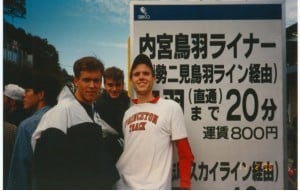
Proof Weldon Ran After College, Ivy League Ekiden in Japan with Sub 4 Miler Scott Anderson of Princeton
Consistency is Key
In college, sure there were some 80, 90, 100 mile weeks but I was not consistent with them. It might be a little harder to do in college as there were a lot more meets. It’s a lot easier to train through a meet when you don’t have one. But I would try and get my mileage up towards the end of the summer, at the start of XC, over the winter and over spring break. Looking back I think I would have been a lot better off if I took a longer term approach and tried to consistently get in as many miles as possible and not worry so much about the short term. What you do this week affects what you do in two years.
Plus in college, I would miss time here and time there. I iced a part of my body every single day after my runs (I ran too much on pavement and ran too hard). And the #1 key to running fast is staying healthy. Because you can’t get in that consistent aerobic training if you’re out for 2 weeks. In college, I’d often miss a few days here, a few there, and at some point it adds up. Four years of college seems like a long time when you are in it, but it is a very short time in times of running, and if you miss a season here or a season there, you are missing out on significant training time.
As I said, I ran a decent clip most days and tried to pound my intervals so something had to give. I think I would have been healthier if I ran more, but at a slower pace on my easy days. It would have let my body recover. A friend of mine raced one track race his entire college career until his senior year. He was constantly injured but really enjoyed the sport.. Once he got out of college, he was still training, and I told him he needed to run more. He told me his body wasn’t meant to run more. I told him to slow down. Sure enough he called me back a few weeks later and was amazed that he had done his first 70 mile week. So stress on the body is not just from the number of miles you do. Obviously you would like to run on as soft a surface as possible but there have been people who have run high mileage on pavement.
And related to running less in college, I said I had less endurance than I do now. Running less could be a cause of having less endurance, but I think I also had less endurance because of my lack of tempo runs. I was often running hard intervals or hard fartlek but rarely got in the pace work that I feel can really help build your endurance. In college, I might be doing intervals at 65 pace, easy runs at 6:30, and the rare tempo work I did might be in a workout at 6:00-5:40 pace for most of it. Since I could run 10k at close to 30 minutes, it seems like I should have been doing more tempos and stuff at 5:20 pace and faster to down around 5:00. But I rarely did this type of training. I see some stuff at 5:40 pace and perhaps this type of running was hard for me to do since I never practiced running at a moderately hard pace, trying to relax. Most of the stuff I did was “hard” or perhaps “not easy enough” (my recovery runs).
If I had stayed focused on the bigger picture I should have run a lot faster in college. I don’t think I was destined to be a college star, but my success after college and some flashes of promise that I showed in college suggested that I should have raced faster while in school. As I said distance running is primarily an aerobic activity so it makes sense that I or anyone else for that matter should continue to improve once they get out of school. My improvement was much better than most.
But in college, I was too busy trying to hammer that day’s workout, too busy recording my mileage to the quarter mile (or doing a rolling 7 day total, keeping track of the mileage on my shoes, etc), searching for the “secret” to success instead of just getting out and getting in consistent aerobic training. When I worked out, I rarely think I was trying to stay under my threshold. I was going over it and trying to hang on a lot, which is not the proper way to work out. For almost every workout, you should be finishing faster than you start, and you should be trying to find a relaxed rhythm not trying to necessarily run the set of intervals as fast as possible on that day. If you’re going too hard early, you won’t accomplish this. Running fast is a learned activity, and you don’t learn how to do it by running too hard all the time, struggling in all your workouts. Most college runners, let me change that, most runners don’t appreciate this fact. Instead of trying to relax and stay just under their threshhold, they try and muscle through their intervals, struggling to comlete the workout. Much of the effect is lost.
Also in college it seems like there are two types of runners over the summer. Those who are lazy and those who aren’t. If you’re reading this piece and have made it this far most likely you are one of those guys who puts in the work over the summer, running a consistent set of miles, a lot of it fairly relaxed, not working out much (well if you’re in Texas like I was, you’re not working out much). If you’re one of these guys, the temptation is to get back to school and start pounding away at your intervals once you start working out. Just try to resist the urge to do this. You want to be running under your threshold most days, and apply this consistent approach to training you had over the summer to as much of the year as possible. Most college runners I know don’t seem to know how to do a tempo run properly, they either run it too hard like a race or too easy like an uptempo jog. You want to be approaching your threshold. This could be the topic of another training piece.
You Gotta Believe
But most importantly, turning back to Gary Stolz and Vin Lananna, you need to believe in yourself that you’re going to run fast. The All-Americans, the national champs, they are no different than you or me. They just run faster and there is no doubt in their minds they can do it (sure they are nervous on the line. I always said that if I didn’t get nervous before races I would quit running because what would be the point of competing). A lot of people work hard, put in the work, but feel like they are not ready to reach the next level or are not sure they can reach it. Well racing is a hugely mental thing. And if there is any doubt in your mind as to how you’re going to do, when it starts to hurt, you’ll start questioning yourself and that will be it. Say you’re in shape to run 29 minutes for 10k (4:40 pace). 4:50 or even 5 minutes pace is not going to be a walk in the park. So if you are not mentally prepared to race, when you are hanging on for your dear life at 4:45 pace you’re going to question yourself and fall off. However, if you know that you can run that fast, you’ll accept the discomfort as a natural part of the race and hang on and keep going. It’s amazing how we all set mental barriers as to what we can do. Once they run a PR, a lot of people start running that time repeatedly.
And although I wasn’t the greatest runner in college and didn’t really understand how to train or run fast, I should have run a lot faster than I did. I just lacked confidence in my abilities and didn’t believe in my fitness. Instead of trusting all the hard work I put in, I was super anal and would stress out about the latest workout or the latest race. I felt everything had to go perfectly for me to race well. Now, a bad race, a bad workout doesn’t faze me. I know running fast is not that complicated. In 2003, I was coming off of injury. I ran a 28:54 10k in my first 10k on the track. Then I had some sporadic workouts and dropped out of my last race right before nationals. There is 0 percent chance in college I would have run well after this. I would have thought “I’m not that fit. I can’t run that well.” If I had toed the line with that attitude there is no way I would have run well. Instead, I went into nationals knowing I had to be in better shape than the 28:54 since it had occurred one month before and I had had a few decent workouts since then (and some crappy ones). I went out and ran the best race of my life a 28:06 pr to get 4th at nationals.
There are a lot of good college runners out there. 10 seconds a mile is not very much, but it can be the difference between being a mediocre runner and a pretty good one. The best runners are not necessarily the most “talented” (although talent helps a lot). But what is “talent” anyway? I had just as much “talent” in college as I do now, yet I was that good. If you learn how to run fast (which I equate with learning how to train), put in the work consistently (this is a key ingredient I’m glossing over a bit) and believe in yourself, pretty soon you may discover that you are the “talented” one.
Good luck.
Below I go through my college career year by year:
| 1500 | Mile | 3,000 | 5000 | 10,000 | |
| Freshman | 4:35 | 8:54 | 15:18 | ||
| Sophomore | 4:03 | 8:35 | 14:54 | 30:37 | |
| Junior | 3:55 | 4:15? | 8:26 | 14:30 | 30:19 |
| Senior | 3:55 | 8:24 | 14:35 | ||
| Fifth Year | 3:52.8 | 8:33 | 14:34 | 30:14 | |
| Bests | 3:52 | 8:24 | 14:30 | 30:14 |
Extra:
Real quickly I’ll run through my college years and add some comments:
Freshman year:
XC:
I didn’t run track until my senior year of high school (I had done XC every year but hadn’t done track since the 7th grade) and ended up running 4:29 and 9:35. My goal going in to college was to run for 2 years and see if I could run in college (I thought if you averaged 5:30 a mile for XC, that was what it took to run Division 1, shows what I knew); if not I might move on and do something else. I got a stress fracture at the start of the summer so I missed some time. I cross trained like mad and fortunately for me we had a horrible XC team my freshman year so I ended up making the varsity by the end of the season. I ran JV the first two meets (HYPs and Heps), and at Heps our team did absolutely horribly. My time in the JV race would have put me in the top 7. And as Coach named off the guys who were going to get to run the regional race, I was hoping he’d say my name. Fortunately, he gave me a shot. I was so excited. At regionals, the top 5 lettered and that was my goal. Problem was I was the 7th guy on a bad team. Fortunately for me, one guy got a bad cramp and was grabbing his side and another guy I’m not sure what happened to him, he was lying in the grass (I think with a cramp as well) as I came around. I couldn’t believe it, I actually lettered.
Track:
In track, my freshman year I ran indoors but missed most of outdoors with an accessory navicular (an extra bone chip on your foot. The pain finally went away after some time off but that is the foot that bothers me now, so I wonder if that is some of the cause of my problems now). I wasn’t very good but I still hated to lose which has gotten me a long way in the sport. I think it was my first race indoors, I ran an 8:56 3k in the 3rd of 4 sections of the 3k at the Yale Invite. I got edged out at the line. For some unknown reason that still baffles me today, I let out an F-bomb at the finish. Coach Bartold came up and told me to watch my mouth, but deep down I think he liked the competitiveness I showed. I also ran a 15:18 5k my freshman year. This was just around when Gebrselassie was coming on the scene and running under 13:00, making it look easy. I remember at one point, actually think about how fast he was running and concluding there was no way I was coming close to the Olympics. I ended up getting hurt and missing most of the outdoor season which gave me a fifth year at Texas.
Sophomore Year
I was consistently in the top 5 in cross. I see I ran 26:44 on Van Cortlandt and 26:51 another time (the course was a lot slower then than now, but this is still not a good time). In track, I showed I could run at the collegiate level on a decent level, as I ran my first 10ks. The year before I was watching the 10k at the conference meet and decided I could score in it the next year and was right. My first 10k was a 31:10 at the Raleigh Relays and I thought I was going to die. I remember getting half way and thinking “there is no way I can keep up this pace.” However, I was on pace to qualify for IC4As (31:15 was the qualifying) so I couldn’t quit then. I just took it a mile at a time. Even at 5 miles I thought there was no way I was going to make it but I still was on pace. I kept the pace, then kicked the last lap and made it with 5 seconds to spare. Later that season, I kicked a 1:30 last 600 to win the 5k to clinch the Harvard dual meet which is a big deal at Yale (plus Harvard had two studs on their team who were doubling back from the 1500 so it was a good run for me. And everyone told me how Frank Shorter dropped out of this meet with the meet on the line. That is where the Frank Shorter comparisons with me stop). I improved to 30:37 for 5th at the Heps meet and concluded what I thought was a pretty good season. One of my good friends, Erick Hawkins, who had run 9:12 in high school (we were high school teammates as well), had gone to Yale and made us all a lot better. By the end of the season I was working out with him and thought that was something to be impressed with. Baby steps.
Junior Year
XC
I started things off well as I did most XC seasons. I was the #1 man on the team at the meet we went to in Canada. But then I got sick in the middle of the season and didn’t run too well at the Duke dual meet in pouring rain. I figured it was just a minor cold, no big deal. The Duke runners actually stayed in our dorms at this meet. So we had to entertain them after the meet. Everyone went to the football game and of course I went as well despite the rain. I went to a keg party that night as well (no one said college students are smart or can see the big picture). To make a long story short, I ended up being sick for a couple of weeks off and on. Of course I wouldn’t dare miss a workout, so I refused to do the right thing and take time off. I would try and run the workouts hard which only made things worse. I ended up doing a cycle of: take a few days off, try to work out, repeat the process. If I had just stayed indoors, not gone to the kegger, and not tried to workout on Monday, I probably would have been fine in 2 or 3 days instead of 3 weeks. The rest of the season I sucked because of missed training and lack of confidence (any time missed I thought would do me in). I was 5th man at Heps 26:30 39th place I think, and it says I ran 31:57 at IC4As at Franklin Park.
Track: My junior year in track was my most consistent as I didn’t miss any time. I pulled off double victories on one day at the Bucknell-Cornell meet in the mile and 3k (8:32) when my open 3k PR was only 8:31 (which I ran by myself earlier that year) on a day when I had a head cold. I got 2nd at the HYP meet in a PR (8:26) in the 3k to Ian Carswell, who would go on to run 13:37 for 5k once he got out of school, but it was not like I was in his league. He ran 8:21 in that race. I scored in the mile at the indoor Heps meet, and outdoors ran 30:19 at Raleigh Relays. I ran a 14:38 at Penn and there is some note how I felt sick. I note in my log that I “saw Bob Kennedy, Steve Holman” running together by the river at Penn. Clearly I was a running geek to note that in my log (but I was really excited to see them). The sickness carried over to Heps (I didn’t miss any training but in my log, I note I felt like crap a few days, looking back I wonder if it was allergies. I get allergies every spring now. Allergies can make a big difference but even if it was a mild sickness and I was completely over it, I mentally would have let it bother me when I went to the line then) where I ran 31:26 for 5th. I felt tired the rest of the season but rested up a lot and rebounded with a 14:30 5k PR at New Englands. Full Disclosure: I think it was this year that I went with the Arkansas guys and a bunch of others to Atlantic City after the distance races at Penn. We stayed up all night, and one of the Arkansas guys talked about pawning his NCAA championship ring after he lost all his cash at blackjack. We drove back at like 6 in the morning. This is an example of the stupid stuff college kids do that prevents them from running well. Now the Arkansas guys of course went on to win multiple national championships while I got 6th at my conference meet but its probably not best to screw up your sleep the week of a conference meet. Of course, the Arkansas guys got back at 6 am and had a long 17 miler at 6:30 am. No joke. I meanwhile just went to sleep. Sleep I believe is the most important thing after running in terms of success.
Senior Year:
XC:
Things started out really well and slowly went downhill for me and the team. I ran 25:56 for 5th place at the Van Cortlandt meet to start the season and felt ridiculously strong the first month of practice. We won a Duke dual meet where I tied for first then we went and raced at Auburn where I ran 25:28 for 38th place. No one on the team was used to racing in a big field and we got lost in the field. At HYPs, the team did even worse. Before Heps, I ended up waking up and having this really bad neck pain. So instead of just taking a day or two off, I went and decided to cross train in the pool. When you’re in the pool running, the only area of your body that is not supported by water is your neck. I barely made it a lap and thought I was going to drown. So then instead of just riding a bike easy for a couple of days, I got on it and went an hour thirty hard with intervals. You get the idea? I couldn’t see the big picture and was always worried the latest workout was going to make or break me. I ended riding the bike so hard, I could barely walk when I got off. Anyway, it hurt to run on the back hills at Heps. My legs were still in pain from the bike and I finished out of the top 5 on our team, for the only time in my XC career. Way to go out with a bang as a senior.
Track:
I missed some time over break as I got sick once again. I came back and ended up running well for me indoors. I got double wins at the Bucknell, Cornell tri meet again (5k and 3k, I seemed to do my best in meets like this because I didn’t have to think about how fast I could run. Coach B just said we have to win this race so I thought of that instead of what pace I should run. It took out the lack of confidence factor that I talked about earlier. Most of us can run a lot faster than we have in the past, we just don’t truly believe we can). At Heps, I fell off the pace midway through the race but started coming on late, but the leaders kicked right before I caught them and I finished 3rd, my highest finish in an indoor pr of 14:35. I then got All-East at the IC4A indoor meet which was an accomplishment for me.
Outdoors, I got sick (or allergies. I realize now I get allergies every spring and perhaps this is what I had then) and missed the Raleigh Relays meet my senior year. I ran like crap at Penn (15:04 5k with a bad mile the next day, felt horrible the week of my conference meet, and was 6th at the conference meet 10k, and eked out an All-East in the 10k at the IC4A meet (well that’s what I think happened, I can’t find my logs from these last 3 weeks, not sure if I didn’t write the stuff down due to depression or lost them). Not a good way to go out, but I knew in the back of my mind I could do better.
Fifth Year at Texas: I decided to use up my last year of outdoor track eligibility to try to be All-American or at least make the NCAA meet in the 10k. The coach left right before I got there and when I sat down with the new guy to tell him my goals, he said, I was aiming a bit high, maybe I should just try and break 30 minutes. I was pretty pissed off, but I guess on paper I looked like a 30 minute 10k guy as I’d run between 30:39 and 30:19 for the last 3 years. Anyway, I ended up running 30:14 at Penn, a 5 second PR from my junior year but still disappointing. I was trying to incorporate some of the training ideas of JK into my training but it is impossible to mix and match things like that. I didn’t score at the Big 12 meet as I was 10th in the 5k and 10k as I sucked to begin with and had my spring allergies.
I still knew I could run a lot faster than I had if I trained properly. In the last 2 years I had improved only 5 seconds in the 10k, but I knew I was a much better runner than I had showed. I had my coach JK write me up a 4 year plan and although I didn’t reach any of my goals until 2000, he said I could run under 28:30 for 10k by 2000. Sure enough somehow he was right.
Weldon can be reached at weldonjohnson@letsrun.com
*There is a message board thread on this article here