American stars Keira D’Amato, Betsy Saina, Sara Hall, and Emma Bates lead US charge for Sunday’s Chicago Marathon
After Olympic Trials disappointments, a strong field of US women chase redemption in Chicago
By Jonathan Gault
Only three women leave the US Olympic Marathon Trials truly happy. And at the 2024 Trials on February 3 in Orlando, three of America’s fastest female marathoners ever were not among that number.
Keira D’Amato (2:19:12 pb, #2 all-time US), Betsy Saina (2:19:17 pb #3 all-time US), and Sara Hall (2:20:32 pb, #5 all-time US) all came to the Trials with the expectation of making their first US Olympic team (Saina ran at the 2016 Olympics for Kenya before becoming a US citizen and switching allegiance in 2021). Yet each would leave the race heartbroken. D’Amato, who led early on a warm day in Florida, was the first to go, losing touch with the leaders during mile 17 and dropping out a few miles later. Saina and Hall were locked in a battle with Emily Durgin for the final Olympic spot at 20 miles, but Hall would fall back during the next mile and finish 5th. Saina would remain in contention until mile 22, when eventual third-placer Dakotah Lindwurm caught her. That’s when Saina, realizing she could not last another four miles, stepped off the course.
Now, eight months after Orlando, D’Amato, Saina, and Hall will reunite on Sunday at the Bank of America Chicago Marathon. With three sub-2:17 women in the field (two-time Chicago champ Ruth Chepngetich, 2024 Tokyo champ Sutume Kebede, and former NYC/London champ Joyciline Jepkosgei), none are likely to challenge for the overall win. But, along with Emma Bates, who was forced to withdraw from the Trials due to injury, they form the core of a very strong American elite field.
With a field this good and favorable conditions in the forecast (temperatures in the 50s, partly cloudy, though 10+ mph winds could be a problem), there is a temptation to assume we will see a four-pronged assault on the American record. That these women, motivated by their Trials disappointment, will earn redemption by running faster than any US woman ever has.
And maybe that happens. After Deena Kastor held it for almost 19 years, the American record has been broken twice in the last 21 months, first by D’Amato (2:19:12) in Houston in January 2022, then by Emily Sisson (2:18:29) in Chicago in October 2022. Sisson’s time is more than six-and-a-half minutes slower than Tigst Assefa‘s 2:11:53 world record, which means there is still plenty of room for improvement.
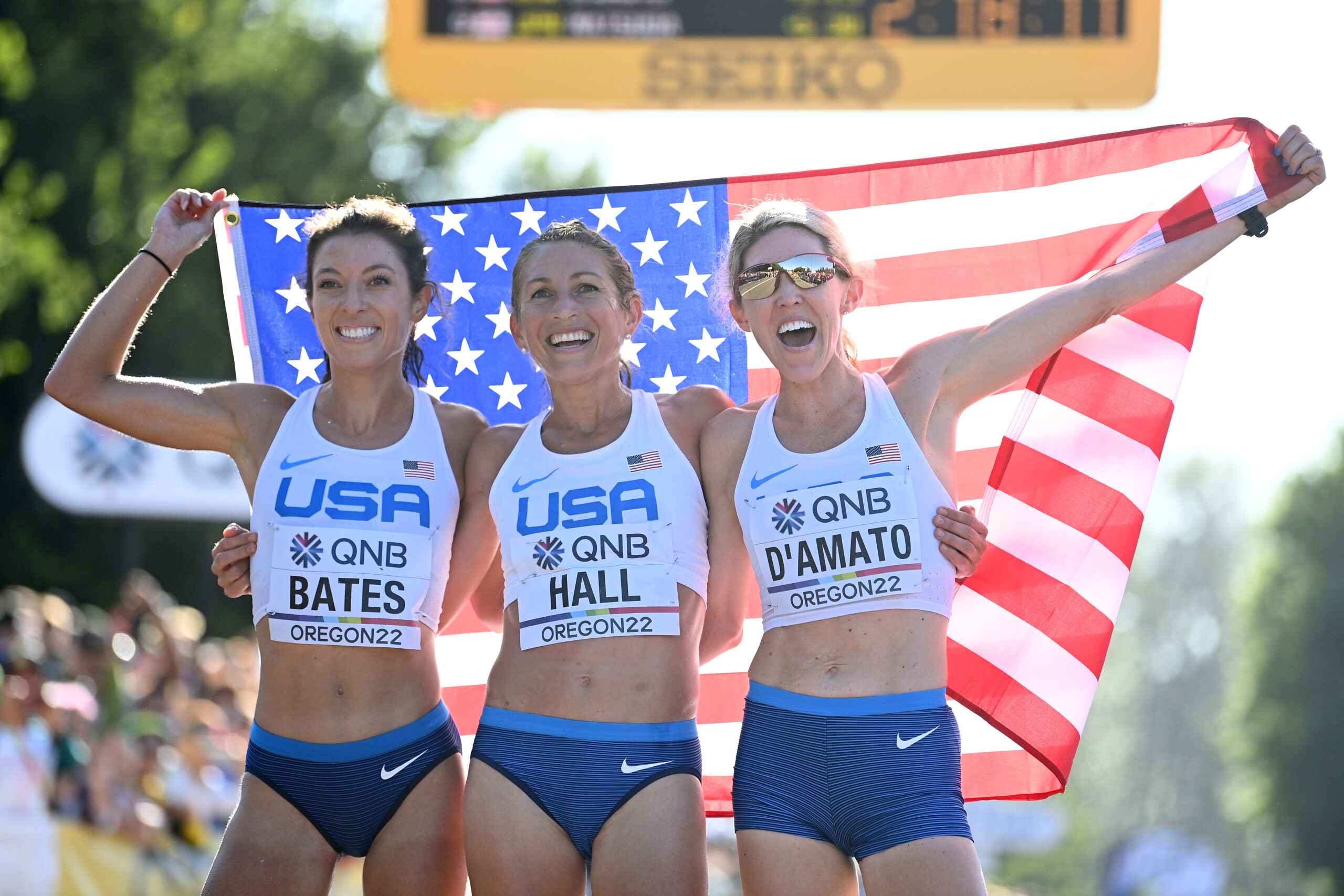 Hall (5th), Bates (7th), and D’Amato (8th) all finished in the top 10 at the 2022 World Championships in Eugene (Photo by Hannah Peters/Getty Images for World Athletics)
But it is telling that no woman has stepped forward and announced plans to attack the record. Each has a reason to be cautious. D’Amato has uprooted her life by moving to Utah to be coached by Ed Eyestone. Her training has gone well, but it’s hard to project her exact fitness after just one buildup in a new system. Saina was hoping to go for the AR this fall but missed a chunk of training after injuring her knee in a fall in July; as recently as August, she did not even think she’d be racing in Chicago. Hall is 41 and told LetsRun.com she felt overcooked early in this buildup, though she said things have been coming around recently. And Bates’ pb of 2:22:10 is nearly four minutes slower than the AR.
Regardless of how fast they go, there should be a fun battle for top American honors in Chicago. Not only do we have four of the biggest names in US women’s marathoning going at it; we’ve got an Olympic champion handling pace duties. That’s right. 2016 Olympic 1500m champion Matthew Centrowitz, who retired from pro running earlier this year, will be pacing the lead group of American women in his marathon debut. In so doing, he will follow in the illustrious footsteps of LetsRun.com’s own Robert Johnson (pacer in Catherine Ndereba‘s 2:18:47 at 2001 Chicago) and Weldon Johnson (pacer in Paula Radcliffe‘s 2:17:18 at 2002 Chicago). Both of the Johnsons’ pace jobs resulted in world records, so Centro has a lot to live up to.
(2003 column: Escorting Paula)
Okay, that’s enough kissing up to my bosses. Let’s dig into the race, starting with D’Amato, who is the most intriguing American in the field after her massive shakeup this summer.
***
A former American record holder goes to altitude for the first time
When Keira D’Amato first started discussing the possibility of making a coaching change with Ed Eyestone earlier this year, the veteran BYU coach poked some fun at her when she mentioned she had never trained seriously at altitude before.
“I said, Keira, you’ve done what you’ve done – American record holder in both the half and the full marathon at one point – and you’ve never really done altitude?” Eyestone says. “And she said no, not for any extended period of time. And I said, You have seen that elites are doing that, right? Kind of facetiously.”
Eyestone chuckles, recalling the moment.
“It’s not a new concept,” he says. “It’s just something that she hadn’t experimented with at that point in time. I said, Well do I have a deal for you.”
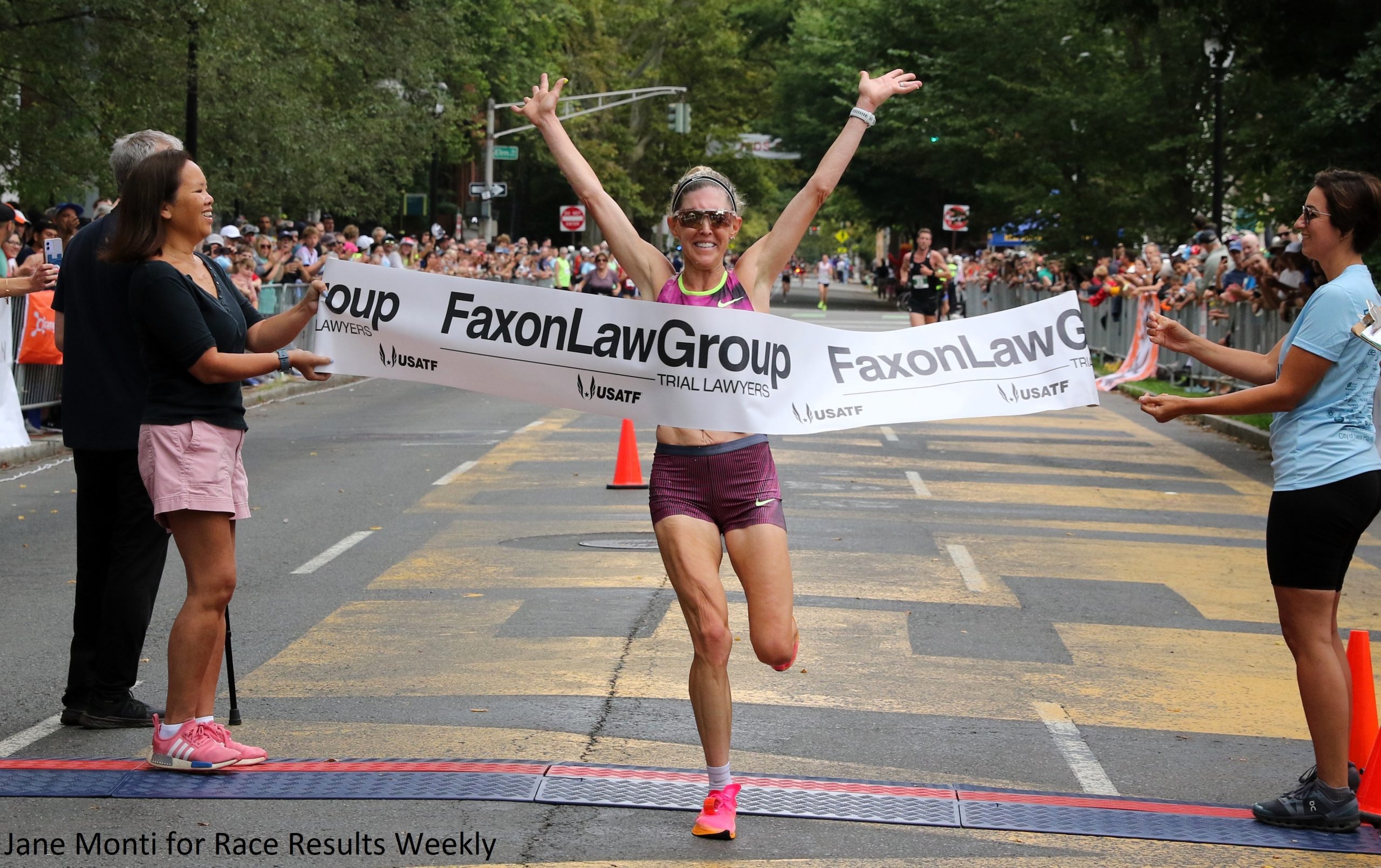 Keira D’Amato wins the 2024 USATF 20-K Championships at the Faxon Law New Haven Road Race (photo by Jane Monti for Race Results Weekly)
It is hard to comprehend that D’Amato could run 66:39 and 2:19:12 while based at sea level in Richmond, Va., but then again, very little of D’Amato’s running career has followed the traditional script. Most successful pros don’t take eight years off in the middle of their prime, return to the sport, and set the American record in the marathon at age 37 despite running less than 85 miles per week. D’Amato reached heights few believed possible under her former coach, Scott Raczko, but after failing to make the Olympic team this year in the marathon or the track (she was 10th in the 10,000m at the Olympic Trials in June), D’Amato took a risk by moving to Park City, Utah, for the summer. What began as an experiment has blossomed into something more as the rest of D’Amato’s family — husband Anthony, son Tommy, and daughter Quin — have moved out there with her for at least the 2024-25 school year. And perhaps longer.
Eyestone believes the new partnership makes sense for both parties. Utah now rivals Flagstaff as the place to train for American distance runners. Four of the five Olympic distance medals won by Americans this year in Paris were earned by athletes either based in Utah (Grant Fisher, Kenneth Rooks) or who spent time there this year (Cole Hocker). One of the draws is Eyestone himself, who coached 2/3rds of the men’s Olympic team in the men’s steeple (Rooks and James Corrigan) and marathon (Conner Mantz and Clayton Young).
Though Eyestone has a long and decorated career coaching men at the collegiate and professional level, his previous experience coaching women was mostly contained to a few sub-elite locals. But when D’Amato, whom he knew from their time doing the Chicago Marathon broadcast the last two years, reached out this summer, he was happy to take her on. Since then, he has also began coaching fellow female pros Makena Morley and Aubrey Frentheway, both of whom are also racing Chicago.
D’Amato began her buildup in Provo (elevation: 4,549 feet) for a more gradual adjustment to altitude but has been based in Park City (elevation: 6,900 feet since), though she’ll come down to Provo for workouts and long runs. Eyestone is pleased with how the segment is gone. She has been topping out at close to 95 miles per week, more than she would typically run under Raczko, but has done it in just six days.
Unlike Eyestone and most of his athletes, D’Amato is not a member of the Church of Jesus Christ of Latter-day Saints, so she does not have a religious reason for resting on Sundays. But from a coaching perspective, Eyestone likes that his athletes get a break of almost 48 hours to reset between long runs on Saturday and their first run of the week on Monday morning. Eyestone does not force D’Amato to take Sundays off, but she quickly embraced the idea.
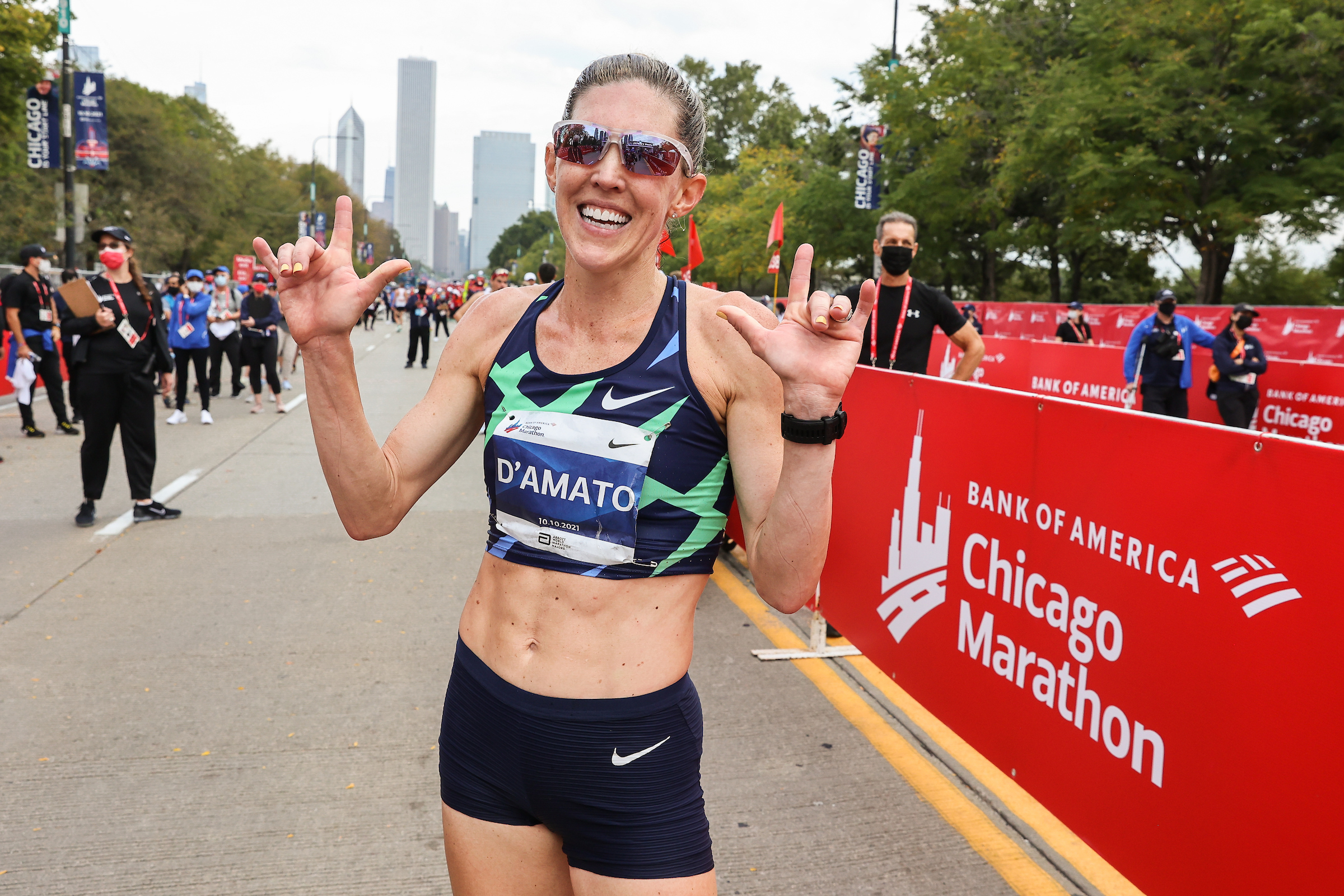 D’Amato last ran Chicago in 2021, where she finished 4th in the women’s race © 2021 Bank of America Chicago Marathon/Kevin Morris
“We work like dogs Monday through Saturday and then we just kind of collapse and recover,” Eyestone says. “An important part of training is recovery, and Sunday’s a nice recovery day for us all.”
D’Amato turns 40 on October 21. And while it’s possible to run well deep into one’s 40s (see Edna Kiplagat and Sinead Diver), it’s hard. The question is whether the new stimuli of altitude and a coaching change can offset any age-related declines D’Amato may experience.
“We all acknowledge that the older we get, the harder it is to hit those PRs,” Eyestone says. “You’ve gotta do some really good stuff just to keep from the backslide, sometimes. And I think she’s done some really good training.”
Because this is her first marathon in a new system, D’Amato, who won the US 20K champs in September, is trying not to put any pressure on herself by hitting a specific time. But she should have plenty of help. In addition to Centrowitz, BYU runner Dustin Bybee will also be helping D’Amato. A final decision on target splits will come later this week at the technical meeting, but Eyestone expects a first half of close to 70:00.
“A successful outing would be anything in that low-2:20 range – or under, obviously,” Eyestone says. “If we can come close to her PR, then I think it’s been a very good day.”
***
AR attempt may have to wait for Saina; Hall and Bates return after Boston
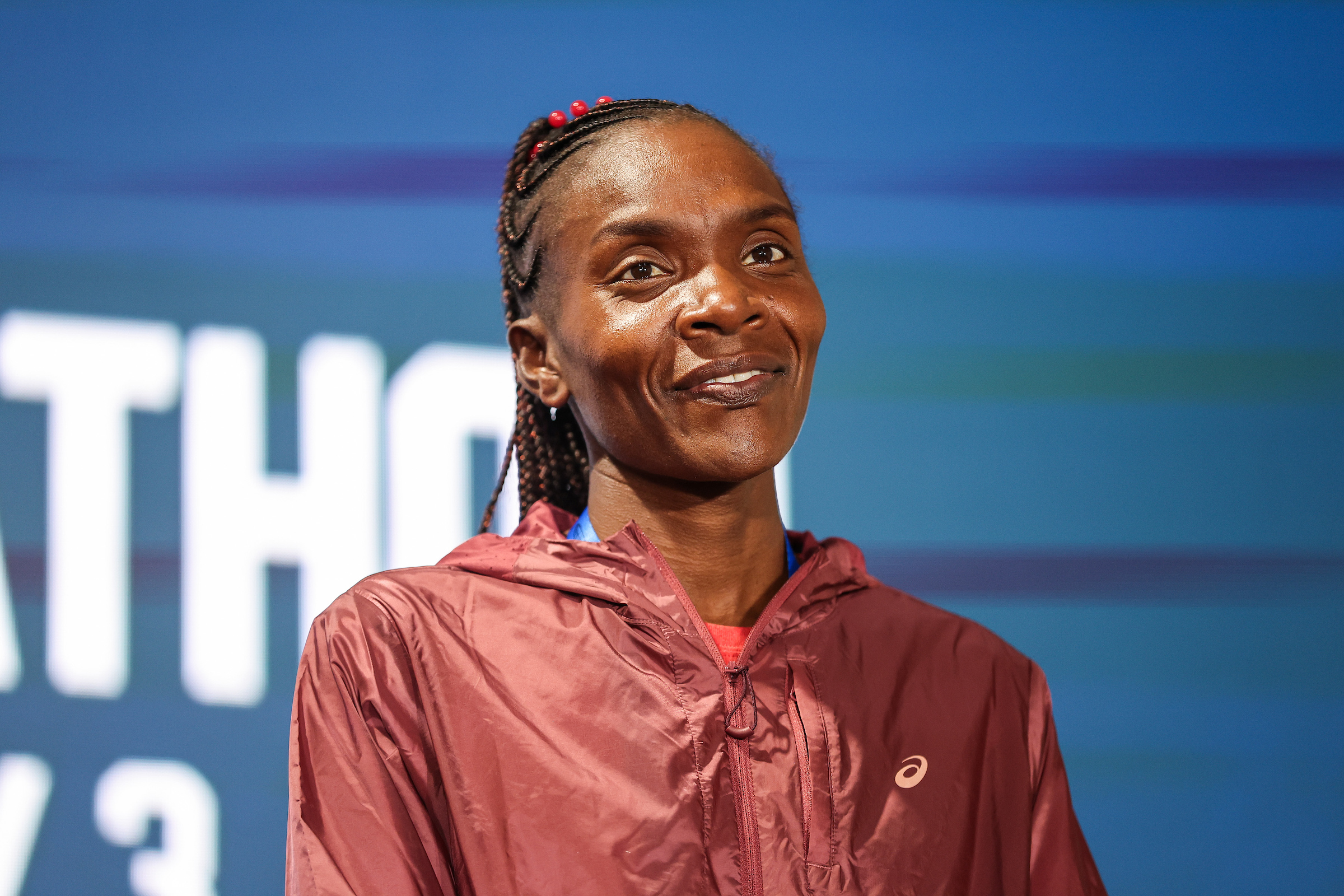 Kevin Morris photo
The 36-year-old Saina showed in March’s Tokyo Marathon why she could one day break the American record. Exactly one month after racing 21 miles at the Olympic Trials, Saina was on AR pace through 35k before fading late to 2:19:17 — still a two-minute pb and good for #3 on the all-time US list. Saina then set an American record of 1:22:32 to win the US 25k champs in May, and set her targets on Sisson’s 2:18:29 American marathon record as she began her Chicago build.
But earlier this week, Saina revealed on the Ali on the Run Show that she injured her knee in a fall in July. She was forced to cross-train for two months and as a result had an abbreviated buildup for Chicago. Saina should still be in the mix with the top Americans, but she told host Ali Feller that she no longer feels the AR is realistic this weekend.
“As an athlete, you have to be realistic and you have to readjust your goals,” Saina said. “…I told myself, let me go to Chicago, let me have some fun and not put pressure on myself and set my goals to next year. Move the goal of I want to run 2:18. And I might come back in three months and do it somewhere else.”
Sara Hall has come to Chicago hoping for the American record before, but her previous attempt, in 2021, was derailed by hot weather. Since then, Hall has not been able to chase a fast time either because of the races she was running (Boston, Olympic Trials) or a cycle of injuries (knee, IT band, SI joint) in 2022-23. It was a source of tremendous frustration.
“There was a point in the injury cycle I wasn’t sure my body could handle this anymore,” says Hall, 41.
For this buildup, however, Hall did not miss any days of training. Not to say it was all easy — early on, she wasn’t hitting the times she is used to seeing in long threshold workouts.
“I think it was a combination of things just leaving me feeling overcooked — not coming off Boston [in April] like I usually do, hitting the track work too hard too soon to try to make a run at the track Trials, [getting] COVID, warm weather on top of super high altitude (she was training at 8,800 feet in Crested Butte, Colo.),” Hall wrote in an email to LetsRun.com.
“Eventually I got to feeling like myself again, and in the end it reminded me a lot of my 2020 London Marathon buildup — one really long grind, mostly in Crested Butte, feeling pretty tired the whole time, but as soon as I tapered feeling really amazing. Towards the end my workout times were similar to that build, not as good as my Chicago ’21 buildup up there. But London ended up being a better race, so I’m hopeful that’s a good sign.”
Hall is taking a similar approach to Saina for the race. She is excited to be part of a strong American field and says her goal is “to have as much fun as possible.” And she is optimistic about what could come next — assuming she can stay healthy.
“Now I’m really excited about the future and my next buildups,” Hall says.
Emma Bates finished just ahead of Hall in her last marathon (12th in Boston in April in 2:27:14; Hall was 15th in 2:27:58). Of the D’Amato/Saina/Hall/Bates group, Bates is the youngest by far at 32 years old, and it was only 18 months ago that she was looking like a candidate to one day break the AR herself. Days before the 2023 Boston Marathon, Bates proclaimed she was ready to run an American record on a flat course and backed it up, hanging with the lead pack through 40k and running a big pb of 2:22:10 — the second-fastest time ever run by an American woman in Boston.
Since then, however, Bates tore her plantar fascia after stepping in a pothole at 2023 Chicago, then developed shin splits in a rushed attempt to rally for the Olympic Trials in February, ultimately withdrawing from that race. When Bates did race again in Boston this year, she did not look to be back in her pre-injury form and only ran 2:27:14 for 12th.
Bates hasn’t done any interviews before Chicago so it’s hard to know exactly where she stands, but she did post on Instagram that training has “been going extremely well” since the Falmouth Road Race in August, where she felt she went a little too hard in running 36:17 for third place.
“[I] took a step back for a couple weeks for the body to get back into marathon rhythm,” Bates wrote. “I’m super happy I took a risk and raced in the middle of a marathon buildup because I sure am prospering now! We timed things perfectly.”
***
What to expect on Sunday
D’Amato and Hall (and maybe Saina and Bates) will have their own personal pacers, plus Centrowitz, who is officially there for everyone but will likely start out on the pace D’Amato wants to run, according to Eyestone. But unless one of the big four is committed to chasing the AR — and it doesn’t seem that way right now — it makes too much sense not for them to run together in the early stages. Whatever pace the top women like Ruth Chepngetich, Sutume Kebede, and Joyciline Jepkosgei plan on running is likely to be too fast. And the difference between 2:20 pace and 2:21 pace isn’t much — just 7 seconds per 5k.
Especially if there is going to be a bit of wind on Sunday, the most sensible plan would be for all of the pacers to get on the same page, shield the American women through the first half or so, and then whoever is feeling good can pick it up from there. Maybe one of them pops a big one and runs 2:19 or 2:20, though it’s worth remembering that Emily Sisson “only” ran 2:22:09 when she finished as top American last year — and that was on a good day for running when the men’s world record was broken.
Who will be the top American woman in Chicago?
-
%
What will the top American's time be?
-
%
JG prediction: If Saina had stayed healthy since Tokyo, I would really like her chances of breaking the AR in Chicago. But her injury changes things. I’ll take D’Amato as the top American in 2:21 instead. But the fun thing about this race is that you can make a case for all four women to finish as top American. It should be a great battle.
My only worry is that we won’t get to see much of it. Because of the pacers, Chicago strings out quickly, and — because the Chicago broadcast is handled by a local news station, we usually don’t get to see much of the midpack battles like this one. Any coverage it does get will likely come in the final miles once the men have finished.
Be sure to come back to Letsrun as we’ll have a lot more Chicago coverage. On Friday at 2 pm ET, we’ll be doing a live video show where we give you the inside scoop from the press conference. Watch it below or on our social media platform.