How a Former 18-Minute 5K Runner Broke the Everest Speed Record
Tyler Andrews used double-threshold workouts and pure running fitness to climb from Everest base camp to the summit in under 10 hours
By LetsRun.comOn May 28, American Tyler Andrews shattered the Mount Everest speed record, climbing from Everest base camp (17,598 feet) to the 29,032-foot summit in just 9 hours, 55 minutes, more than an hour faster than the previous record, which had stood for 23 years.
Longtime LetsRun visitors may remember Andrews from 2018, when he appeared as a guest on one of our earliest podcast interviews, before LetsRun even had a regular podcast. We were fascinated by his improbable rise from an 18-minute high school 5k runner to a world-class ultrarunner and featured him in our Where Your Dreams Become Reality series right before he broke the 50 km world best on a track. Eight years later, the two-time Olympic Marathon Trials qualifier has gone from chasing a 50km world best to reaching the summit of Mount Everest faster than anyone in history.
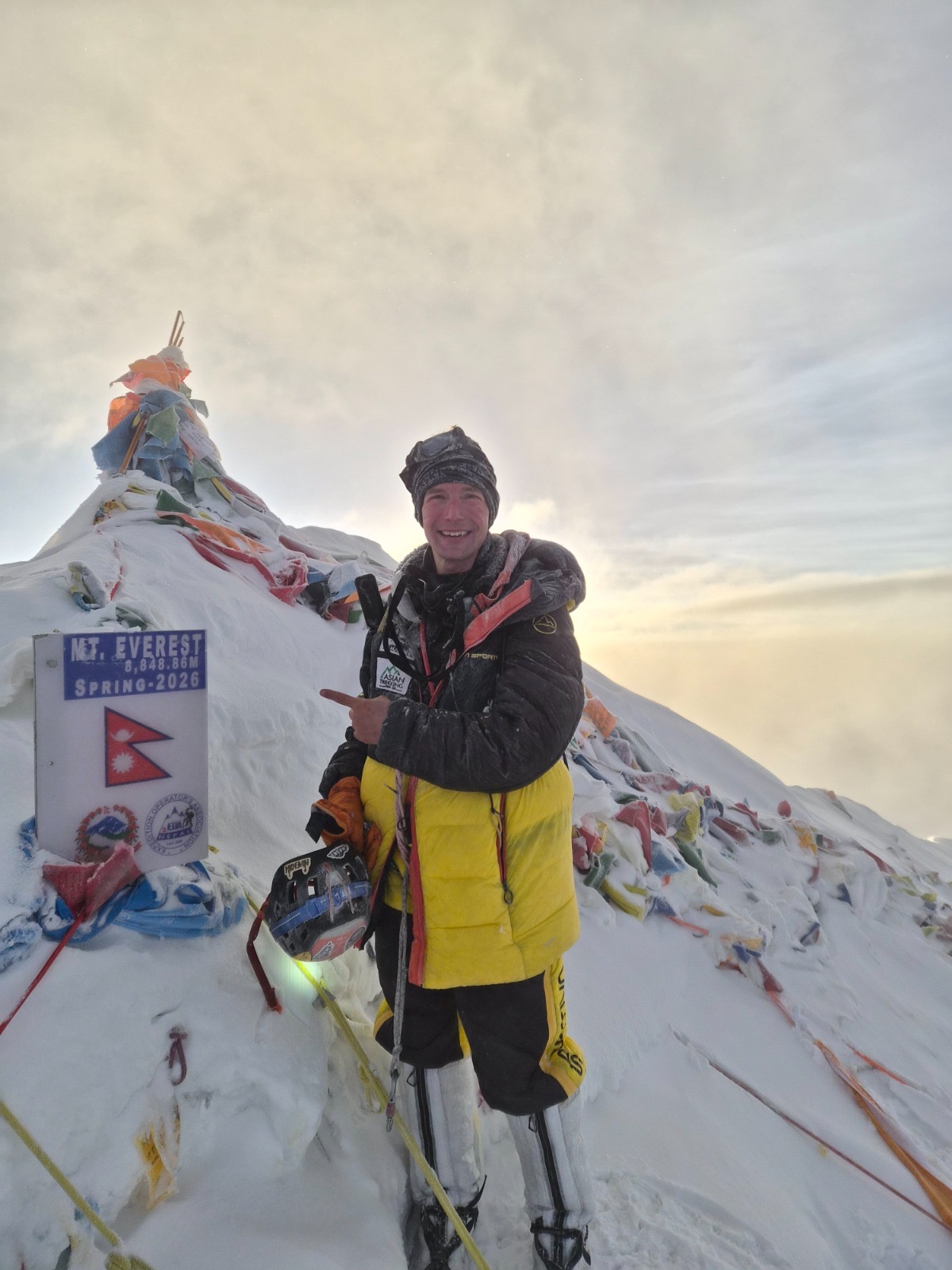 Tyler Andrews at the top of Mt. Everest (photo via Tyler)
While Andrews, 36, made it from Everest base camp to the summit faster than anyone in history, the achievement hardly came overnight. He had gone 0-for-6 in previous attempts to reach the summit. Across three Himalayan seasons, high winds, heavy snow, exhaustion, crowds, and even a broken boot zipper repeatedly derailed his quest. On lucky attempt number seven, everything finally came together.
His climb began shortly after sunset, with a nighttime crossing of the notoriously dangerous Khumbu Icefall before a dawn summit.
On this special edition of the LetsRun.com Track Talk Podcast, Andrews explains how he ended up chasing speed records on the world’s highest mountain, why double-threshold training became a key part of his preparation, and why a return to the marathon, perhaps even the 2028 Olympic Marathon Trials, may still be in his future.
Listen in the player below or on your favorite podcast platform here.
The following are selected highlights from our conversation with Tyler Andrews. Responses have been edited for brevity and clarity, and the order has been rearranged from the original interview.
After six failed attempts, when did he finally realize the record was his?
Andrews: “I went into this 0-for-6. I’d tried six times and failed six times in a row. So there was definitely a lot of me that was just waiting for something to go wrong because up to this point, something had always gone wrong.
“It really wasn’t until I got pretty much up to the South Summit, which is just about a hundred meters below the final summit, where you can finally have a straight line and you’re like, ‘Okay, the summit is right there.’
“I knew I had plenty of time. I’m gonna make it. Nothing is gonna happen unless it’s something really catastrophic.
“That was kind of where I finally let myself relax a little bit and say, ‘Okay, this is gonna be the day.’ But up until that point, honestly, it was a lot of just waiting for the other shoe to drop and like, ‘Gosh, what’s gonna happen this time?'”
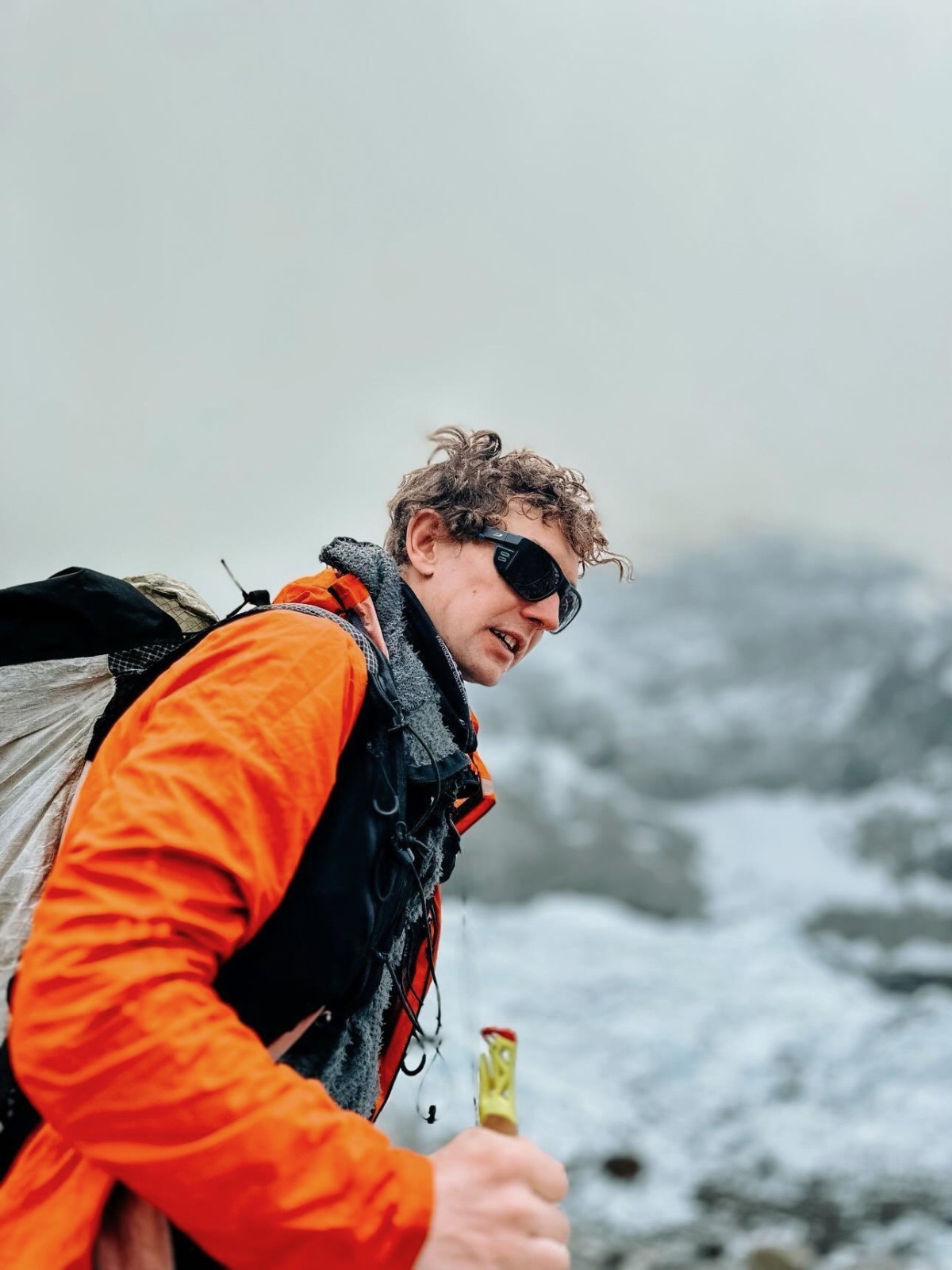 Tyler Andrews (photo via Tyler)
Could he enjoy the summit?
Andrews: “I knew I had a pretty big cushion, and I also knew it was probably the only time in my entire life that I’m gonna be up there.
“I spent maybe 20 or 25 minutes on the summit. You can actually see down to base camp from the summit, so you have line of sight and you can make a radio call down there. I was able to talk to my team down there, my partner. I was actually even able to get my parents from America on speakerphone over the radio to say hi to them. They’re back in Massachusetts, so that was pretty cool. All the way from the summit to Massachusetts.
“I definitely enjoyed it. I wasn’t looking at my watch, but I was pretty surprised when it was time to head down. I was like, ‘Oh my gosh, it’s been almost 25 minutes. I need to get out of here.’…
“I think I let myself relax for the 20 minutes or so I was on the summit, and then it was super focused from that point on. There’s a statistic, it’s like 90% of accidents happen on the way down because you’re fatigued, because gravity is working against you now. The most focused time, and the very last thing that you have to do, is come back down through the Khumbu Icefall, which again, to me, is the most objectively dangerous part of the route. And now for me at least, I was doing it during the day. It was, I think, 9:00 or 10:00 in the morning, which is even more dangerous than doing it at night…
“So yes, I definitely let myself not totally go crazy, but enjoy the moment and celebrate on the summit, but once I started going down, I was super focused and moving quickly, but moving really carefully.”
Why start the attempt at 7:11 p.m.?
Andrews: “The Everest South Side route, which is what I was climbing in Nepal, starts with a pretty famous section called the Khumbu Icefall, a big broken glacier with huge blocks of ice. Some of them are the size of multi-story buildings. It’s dynamic. They’re moving.
“The idea is you want to go through that part not during the day. You want to go through that at night. Ideally, actually, you’d want to go through later at night or really early morning. But because I was looking to summit in the morning, we started as late in the day as possible, right after sunset, so that it’s nice and cold and everything is solid because otherwise stuff is crumbling, it’s tipping over, it’s falling, and that’s not ideal if you’re under it.
“The other reason is that an ideal time to summit is usually early in the morning because in the midday to late afternoon you start getting a lot of wind on the mountain. That can be a really big problem in terms of frostbite and safety. It can literally blow you off the mountain.
“Those are the two reasons. You’re really trying to work from both ends, from getting through the Khumbu Icefall in the dark and also being on the summit at a time that the weather is as stable as possible.”
What went wrong in his first six failed attempts to summit?
Andrews: “Gosh, a lot went wrong. I think after that first season, my biggest takeaway was just this: it’s such a complicated project.
“Everest has so many different things that make it complicated and hard, and they’re all kind of interconnected. It’s hard in a really complex way because you have all these different factors, you have all these different points of failure, each one is interconnected with the other.
“For example, the weather is something that we look at constantly because the weather impacts everything from what I’m doing to what other people on the mountain are doing, to what my crew is doing, to how the equipment works. You could have a weather failure which causes an equipment failure.
“The very first time I went up, for what it’s worth, I really thought before this that this was going to be one and done. I was like, ‘I’m gonna have no problem with this,’ because I’d been coming off a couple of really successful seasons in the Himalaya.
“What really turned out was that first attempt, one of my boot zippers broke because it was really cold and the metal essentially was too brittle. The piece that you pull to close the zipper cracked right in half. Now suddenly I’m at 23,000 feet with one boot that works, and that was a pretty big problem.
“The crowds are another really big one because, again, the crowds take all of these good days in the middle of the season, which really condenses the amount of time that we have to work with on the speed-climbing side.
“Suddenly you have this situation where it’s May 27 and the mountain is closing on May 29 and you only have one day essentially that you can go up there. If there’s 100 other people going up the mountain that day, then you’re SOL.
“So there’s all these different things that come together.”
What actually happened on the six failed attempts?
Andrews: “To give you a really quick summary [of the failed attempts], [the first one] it was the boot. Then the second time it was too windy to continue going safely. The third time was three days after the second time, and I was honestly just cooked. The fourth and fifth times it was really snowy, really heavy snow in the autumn season, which basically shut down that whole season. Number six was just a couple of days before the successful attempt, and that was also basically a wind day.
“It’s a really complicated project. It’s super hard, and it’s hard to get right. You just need everything to kind of go perfectly together.
“I think this season I was in the best shape I’ve ever been in. I was really happy to have a successful training block. But at the same time, there is an element of luck, and there is an element of having all these different factors come together perfectly on that day, and be super, super fit.
“The fitness was the easy part. Then you have to have all these uncontrollable factors outside of your own control come together.”
What does training for the fastest ascent of Everest actually look like?
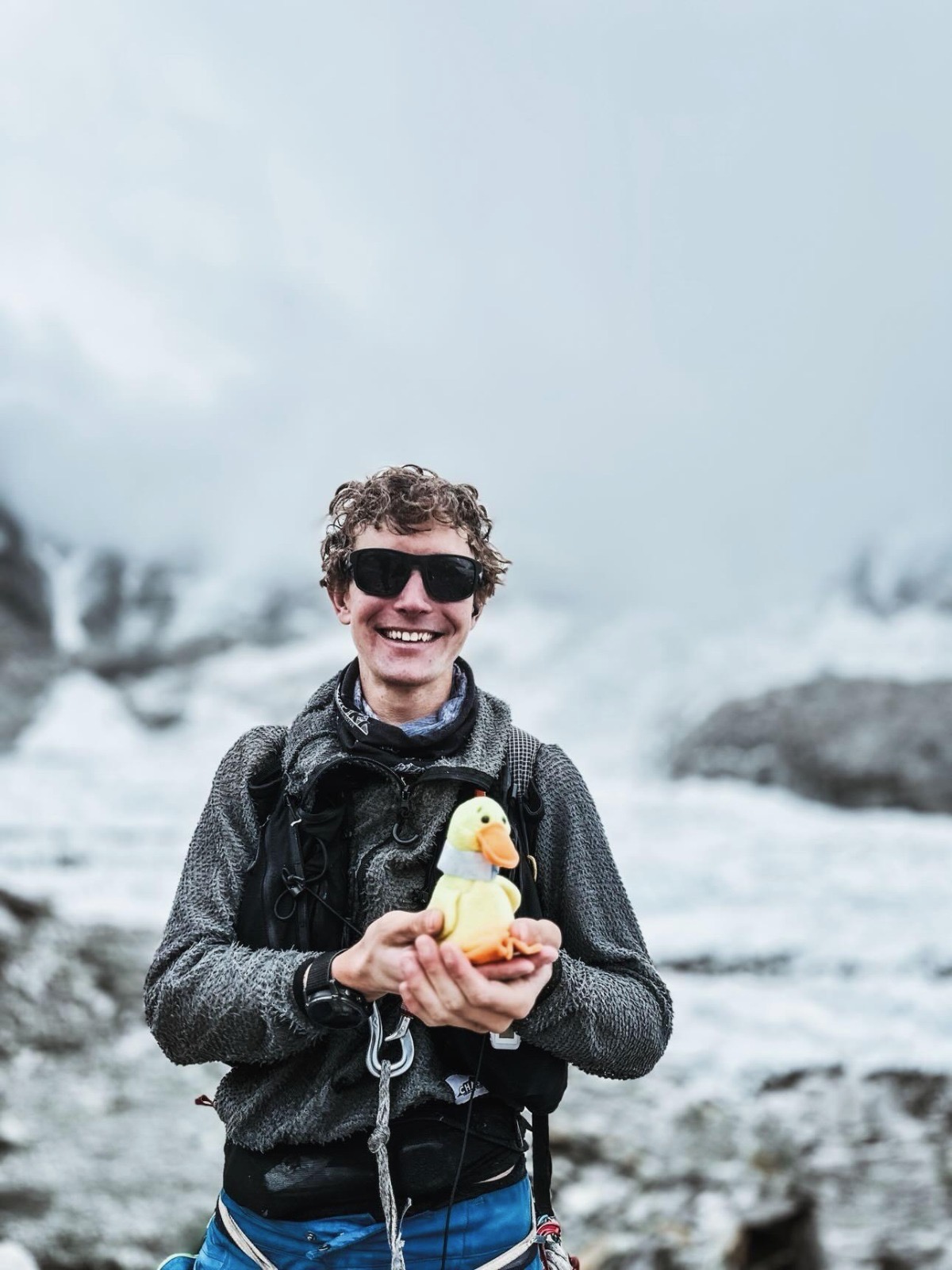 Tyler and Quackers, the childhood Beanie Baby, that has looked after him on his adventures around the world
Andrews: “I don’t think anyone knows. I’ve kind of figured out what works for me over the last couple of years.
“Before going to Everest, I did a speed record on Manaslu, which is the eighth-highest mountain in the world. It’s one of the fourteen 8,000-meter peaks. I learned a lot in doing some training for that.
“Honestly, it is more running than you might expect. I follow LetsRun. I’m about to listen to the Marius Bakken podcast, and I’ve been doing double-threshold applied to mountaineering stuff for probably five years now.
“A lot of uphill on the treadmill or StairMaster, or outside on a long hill if I have access to it. It’s really taking the same concepts that we’re seeing in track & field, that marathoners are doing, but applying them to something where uphill movement is really the primary focus.”
Double threshhold training
Andrews: “For probably the last six months before the Everest climb, I was doing basically double-T days twice a week. I would do something in the morning. Usually the morning thing would be outside on a steep hill. We have a 6,000-foot climb where I live in Quito, Ecuador, so I would use that for my morning session. Then in the afternoon, for a little bit more control, I would do treadmill stuff.
“I was doing lactate testing and everything there. Both of those sessions would be actual running. Again, it’s not fast in terms of horizontal pace, but if you look at the Strava app or something like that, those are pretty solid efforts.
“Once I got to the Himalaya, it was similar. I would do something like a longer threshold session in the morning, but outside on a glacier. Then I actually had a stationary bike that I would use for a second session often in the afternoon.
“Honestly, it’s just a tremendous amount of volume. The double-T days are a really good way to get the higher end going. Then the altitude is the other really big crux of a project like this.
“Ecuador is my home base, so that’s a little more than 9,000 feet. That was my first three months. Then I was in Nepal living at about 5,000 meters, about 16,000 feet, for almost two months, getting up to 20,000 feet almost every day.
“The other piece was true hypoxia training. Using an altitude machine that you would generate for an altitude tent, but I often used it with a mask while I was exercising. I’d use that on the stationary bike or on the treadmill.
“The interesting thing is that those machines actually stack on the altitude that you’re at. In Quito, for example, my altitude machine can go to almost 10,000 meters, which is higher than the summit of Everest. Then I brought one of those to Nepal, and it could go even higher, like 33,000, 34,000, 35,000 feet, which is pretty outrageous. What planes fly at.
“I was exercising ten or twelve hours a week at that altitude for the last month or so ahead of the project.
“It’s kind of a multi-pronged approach where, yes, you want to train threshold, you want to push up the Zone 2 ceiling, a ton of volume, a lot of uphill, a lot of strength training, but then also the hypoxia.
“There are a lot of different pieces to the puzzle.”
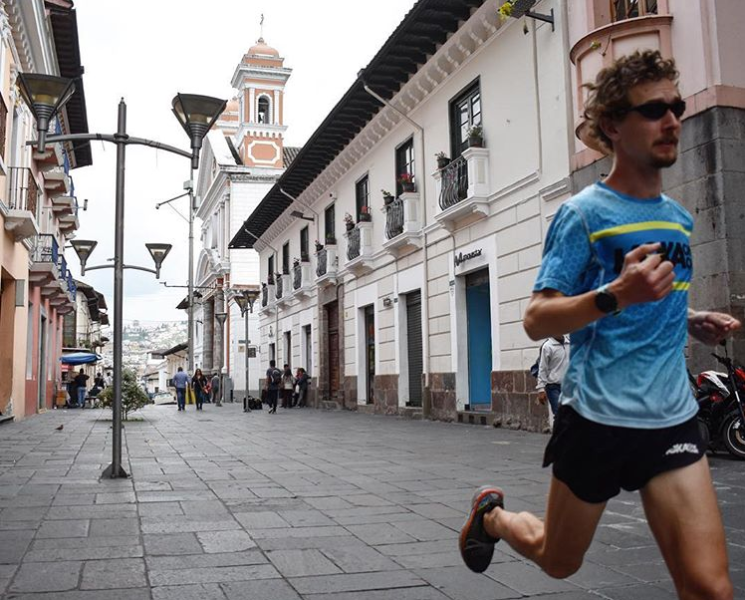 Tyler training back in the day in Quito (via his Instagram)
How many miles a week was he training?
Andrews: “The horizontal distance was really low. It was probably 70 or 80 miles a week maximum of horizontal distance, but the vertical distance was crazy.
“I don’t know, I think I had a week where it was almost 20,000 meters, maybe 60,000 or 70,000 feet of climbing.
“It’s mostly about the vertical distance and the total hours of training that I was paying attention to.
“It was funny because the horizontal distance used to be what I was totally obsessed with as a runner. I did a lot of running mileage back in the day. I would run over 150 miles a week.
“Now 70 miles a week sounds like nothing to me, but the training was so hard and it was so time-consuming. It was way harder than anything I ever did in marathon training.”
“Some of it is steep enough that it’s not running. I would say in a normal week, if I’m running 70 miles, maybe 50 of that is true running and maybe 20 of it might be recovery days where I’m on something steep and I’m actually just hiking the whole time.”
How much running is actually involved in climbing Everest and how fast was he going?
Andrews: “The pace is going to be really embarrassingly slow.
“This is from about 6,000 to 7,000 meters. There’s this gently rising valley. That’s about 18,000 to 22,000 feet. You’re already fairly high up at that point.
“I don’t know, maybe I was jogging 12- to 15-minute-mile pace. Someone can go look at my Strava and call me out if it’s slower than that. Running uphill, you’re probably still running at a 10% uphill grade. It just feels a lot easier at that point than the steeper climbing.
“But yeah, there’s definitely some very slow jogging there. Then on the way back down, actually, you’re probably moving decently quick, maybe 10-minute-mile pace or something in that section.”
What Shoes Did Tyler Andrews Wear on Everest?
Climbing Boot:
La Sportiva Aequilibrium Speed
Andrews said he wore the Aequilibrium Speed, a lighter single-layer boot, during his record-setting Everest ascent. He paired it with a custom insulated overboot and electrically heated socks.
How did he become a mountaineer?
Andrews: “I think it kind of started during COVID because, as you guys remember, there weren’t many races to do.
“I actually ran in the 100k time trial that they put together for Jim Walmsley, but other than that there was really not much going on in 2020 and 2021.
“At the time, I was living in Ecuador and started pushing myself and exploring in the mountains a little bit. I found that, in the same way that as stuff got longer in running, as stuff got higher altitude, I tended to do better at it.
“That was really my introduction. Not really having any structure in terms of races and experimenting a little bit with higher-altitude stuff.
“It started in the Andes in Ecuador with 18,000- to 20,000-foot mountains and then doing some bigger climbs, FKTs, records, that kind of thing in South America and the Andes.
“Eventually you look for bigger mountains, and the only ones are in Asia. So you go to the Himalaya.
“Once I came to the Himalaya, I just totally fell in love with it. It’s not just that I’m a very competitive person and want to push myself and try bigger and harder things, but also the Himalayas are unbelievably beautiful and the mountains are incredible.
“Once I started going there, I just couldn’t stop going back.”
Could a return to the marathon be next?
Andrews: “This is my full-time job now. I founded Chaski back in 2020. We’ve actually transitioned that into a full nonprofit.
“We support athletes around the world through coaching, mentorship, and competitive support. We’re focused now on youth athletes specifically. We have a program set up in Ecuador and a different one that’s set up in Nepal.
“I also coach a handful of people one-on-one, but mostly it’s a few hours a week now, and I’m mostly a full-time athlete.
“…I’ve been daydreaming a little bit about the kind of ‘what’s next’ question.
“I did miss the 2024 [Olympic Marathon] Trials, but I’m interested in trying to actually run a marathon in super shoes and get to the 2028 Trials.
“So fingers crossed. We’ll see how that goes.”
Listen to the full podcast here on your favorite podcast app (or in the player below) to hear Tyler discuss Everest crowds, the dangers of speed climbing, how he verified the record, whether Rojo could climb Everest, modern mountaineering technology, why he still dreams of qualifying for the 2028 Olympic Marathon Trials, and the story behind Quackers, the childhood Beanie Baby that has accompanied him on adventures around the world.