Others for the list:
Adam Smith's Wealth of Nations
The Diary of Anne Frank
Mein Kampf
McGuffey Readers
New England Primer
Others for the list:
Adam Smith's Wealth of Nations
The Diary of Anne Frank
Mein Kampf
McGuffey Readers
New England Primer
One that is missing is Novum Organum by Francis Bacon. Described/promoted/established the empirical method of science that was being developed during the Renaissance.
A few are incontrovertible-
1. The Bible: King James Version is most important for literary references, though other translations have more spiritual/religious value imo)
2. Shakespeare: All of them are worth reading, but the more important (not necessarily the best) ones include Hamlet (duh!), King Lear, Macbeth, Romeo and Juliet, Richard III, A Midsummer Night's Dream, Othello, and The Merchant of Venice. If you like poetry, the sonnets are worth reading too.
3. The Origin of Species: arguably no book since the bible has had a greater influence on man's view of his place in the universe.
4. The Iliad and Odyssey: Perhaps the first ever examples of "Western Literature"
I would stay away from The Wealth of Nations, wayyy too dense if you didn't like some of the other stuff.
Some Tolstoy would be good
Der Judenstat, Theodor Herzl
Mein Kampf, Adolf Hitler
? The Bible is from Semitic races not Western Europeans.
Sand County Almanac is an interesting pick, especially because of Leopold's influence on modern ecological thought. However, I feel like for western Civilization as a whole, it really does not have that much influence (although I wish it had more). As a tree hugger myself, I would love to say important environmental works are hugely influential, but I just don't think that is the case. If I was going to select the most influential environmental book, I would have to say Walden by Thoreau or Silent Spring by Rachel Carson.
Pro Semitic wrote:
? The Bible is from Semitic races not Western Europeans.
Are you denying it's impact on Western culture?
Mr. Lo-Fat wrote:
this Q depends how you calculate "influence"--not such an easy thing to do.
1. Newton's Principia (written in Latin)
2. Plato's Republic.
3. King James Bible.
4. Shakespeare's first Folio(1623)--(first compilation of all the plays)
5. either John Locke's Two Treatises of Government
or Adam Smith Wealth of Nations.
I'll go with all six of these. (From Locke, I'll pick the Second Treatise.)
I'll add The Origin of Species, The Divine Comedy, and one of Homer's two epic poems.
That leaves one more. I hate to leave out Aristotle, who may be the greatest of all Western philosophers, but I don't know which single work to cite. From Greek tragedy, Oedipus Rex is a worthy candidate. A case could be made for Thomas Paine's Common Sense, because of its influence on the formation of the most powerful nation in the world, but I don't know that it has any great significance as an intellectual work. Twenty-five years ago, either Das Kapital or The Communist Manifesto would have seemed an easy choice, and I still might select one of them, since the absence of some sort of socialist treatise or tract is striking on a list that includes Locke and Smith.
Depending on how one defines the question, the Koran might very well merit a place on the list. Time will tell.
agree with mein kampf and definitely some machiavelli-- either the prince or the art of war.
Actually there is no Western Culture per se. Europe has been conquered and overrun many times by Rome, Greece, Arabs, Ottomans, Moors, and most importantly by the Mongols. The Mongols civilized Europe for 300 years from 1200-1500. The entire region was enlightened with Chinese technology. White barbarians were taught basic civilization and brought from living with human and animal excrement and urine in caves, mudhuts, and dugouts.
Once A Runner.
Mexicans are the Romans of the Americas.
Good Book wrote:
Actually there is no Western Culture per se. Europe has been conquered and overrun many times by Rome, Greece, Arabs, Ottomans, Moors, and most importantly by the Mongols. The Mongols civilized Europe for 300 years from 1200-1500. The entire region was enlightened with Chinese technology. White barbarians were taught basic civilization and brought from living with human and animal excrement and urine in caves, mudhuts, and dugouts.
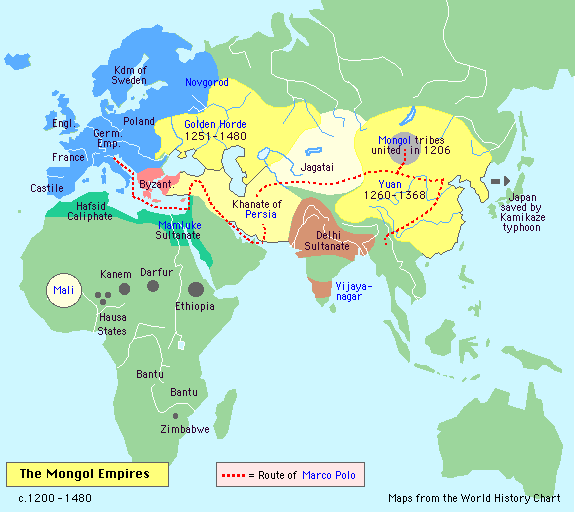
What are you talking about? The Mogols never got farther than about modern day Austria before they turned back after the death of Ogedai, and when they returned, They were repelled handily several times in what is modern day Poland and Hungary. By the early 1300s even their vassal states (such as Thrace and Bulgaria) were no longer sending them tribute, and the Mongols were concentrated in Russia.
And most of the Mongolian invasion involved destruction, not civilization. They destroyed over half the population in eastern Poland and Moldovia, Wallachia, Transylvania and Romania...
Uh did you ever look at a map of Europe ? Austria is halfway to the Atlantic. The Mongols occupied 3/4th of Europe for 300 years. I know the history of the Mongol Hordes has been obliterated from history texts in the U.S. In Europe the Mongols are an important turning point of our history so they are fully taught about in school.
75% wrote:
Uh did you ever look at a map of Europe ? Austria is halfway to the Atlantic. The Mongols occupied 3/4th of Europe for 300 years. I know the history of the Mongol Hordes has been obliterated from history texts in the U.S. In Europe the Mongols are an important turning point of our history so they are fully taught about in school.
You need reading comprehension, I pointed out they got there but never occupied that land...they got there in late 1241, killed off a large portion of the people they fought, then turned around and left in 1242 and never got farther than Hungary again, or north into Poland again. And as I said by the early 1400s the only territory they occupied in Europe was East of Bulgaria...mostly RUSSIA, centered around Kiev. Pretty much after about 1285 the only places in Europe The Golden Horde ruled were what is present day Belarus, Ukraine and Russia(And these Russian areas are usually never thought to be part of Europe proper, even though they are technically in far eastern Europe), as by 1285 they were being routinely repelled in their attempts to take Hungary, Wallachia, Bulgaria, etc, they basically quit by 1300, by 1400 they're influence had fallen back to about the Crimean Peninsula.
The Mongols (The Golden Horde) occupied probably 1/4th of Europe, Mostly Russia, which has long been held to not be "European"
Here is a good map for you and your "3/4 of Europe"
http://www.hyperhistory.com/online_n2/images_n2/mongol1.gifAnyhow, in reply to the OP I would have to say books with importance on Western Civilization:
The Bible
Origin of the Species - Charles Darwin
Mein Kampf - Adolf Hitler
The Aeneid - Virgil
Don Quixote - Cervantes
The Divine Comedy - Dante
Summa Theologia - Thomas Aquinas
The Prince - Machiavelli
Leviathan - Hobbs
his 95 Theses - Martin Luther
On the Revolutions of Heavenly Spheres - Copernicus
Experiments on Plant Hybridization - Mendel
Relativity - Einstein
The Wealth of Nations - Smith
Critique of Pure Reason - Kant
A Dictionary of the English Language - Samuel Johnson
A Treastice on Human Nature - Hume
Common Sense - Paine
Mathmatical Principals of Natural Philosophy - Newton
First Folio - Shakespeare
You will notice that most of these are either Philosophical (including theological philosophy), or Scientific. Then there is Shakespeare, Dante and Cervantes in there. Those three books changed the face of literature.
lets not forget that very important book on the realities of human defecation,
Everybody Poops.
1 post was removed from this page.