Why doesn't the earths gravity make the moon come crashing into it?
Why?
Why doesn't the earths gravity make the moon come crashing into it?
Why?
For the same reason the planets don't go crashing into the Sun.
larry Goldstein wrote:
Why doesn't the earths gravity make the moon come crashing into it?
Why?
ok, i'll bite...
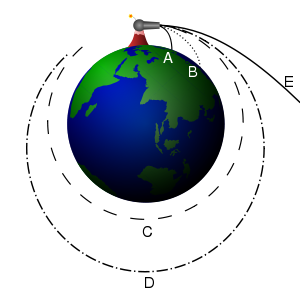
one way to think about orbits is that the moon is always "falling" towards the earth, it always feels the earth's gravity. the reason it doesn't crash into the earth, though, is that it's tangential velocity is high enough that it keeps "missing" us, so it is constantly "falling" around the earth.
here's a nice visual:
http://static.newworldencyclopedia.org/thumb/7/73/Newton_Cannon.svg/300px-Newton_Cannon.svg.pngcannonballs A and B are not fired fast enough and fall down to earth. Balls C and D are fired fast enough that while they do feel the earth's pull and fall towards it, by the time they do the horizon has curved back under them. Ball E has been fired so fast it escapes the gravitational pull.
hope this helps, but i feel like i just got trolled.
Why doesn't the moon's gravity cause the earth to crash into it> Both are orbiting around a common center of mass (of the two-body system), although the system is so dominated by the earth that the center is close to the center of mass of the earth (inside the earth's boundary, I am pretty sure).
With an artificial satellite orbiting the earth the thin but not non-existent atmosphere creates drag on the satellite that slows it down, which brings it closer to the earth gradually. Of course, the process is an accelerating one as the atmosphere gets denser as the orbit gets lower. The space telescope has had its orbit boosted several times to keep it further 'up' and long-lived satellites have very high orbits with little drag (geosynchronous orbits are quite high, plus there are 'nodes' do to gravitational interactions with the moon, etc.).
Of course, the moon does not experience much friction, but there is friction in the tides and complex interactions that transfer momentum from the earth to the moon, according to the following entry porton from Wikipedia:
"The gravitational attraction that the Moon exerts on Earth is the major cause of tides in the sea; the Sun has a lesser tidal influence. If the Earth possessed a global ocean of uniform depth, the Moon would act to deform both the solid earth (by a small amount) and ocean in the shape of an ellipsoid with high points directly beneath the Moon and on the opposite side of the Earth. However, as a result of the irregular coastline and varying ocean depths, this idealization is only partially realized. While the tidal flow period is generally synchronized to the Moon's orbit around Earth, its phase can vary. In some places on Earth there is only one high tide per day, though this is somewhat rare.
The tidal bulges on Earth are carried ahead of the Earth–Moon axis by a small amount as a result of the Earth's rotation. This is a direct consequence of friction and the dissipation of energy as water moves over the ocean bottom and into or out of bays and estuaries. Each bulge exerts a small amount of gravitational attraction on the Moon, with the bulge closest to the Moon pulling in a direction slightly forward along the Moon's orbit, because the Earth's rotation has carried the bulge forward. The opposing bulge has the opposite effect, but the closer bulge dominates due to its comparative closer distance to the Moon. As a result, some of the Earth's rotational momentum is gradually being transferred to the Moon's orbital momentum, and this causes the Moon to slowly recede from Earth at the rate of approximately 38 millimetres per year. In keeping with the conservation of angular momentum, the Earth's rotation is gradually slowing, and the Earth's day thus lengthens by about 17 microseconds every year. (This would make each Earth day one second longer every 60,000 years or so, and one minute longer every four million years). Looking back, the day was 15 minutes shorter when the dinosaurs roamed the Earth 65 million years ago.) See tidal acceleration for a more detailed description and references.
The Moon is gradually receding from the Earth into a higher orbit, and calculations[3][4] suggest that this would continue for about fifty billion years. By that time, the Earth and Moon would become caught up in what is called a "spin–orbit resonance" in which the Moon will circle the Earth in about 47 days (currently 29 days), and both Moon and Earth would rotate around their axes in the same time, always facing each other with the same side. However, the slowdown of the Earth's rotation is not occurring fast enough for the rotation to lengthen to a month before other effects change the situation: about 2.1 billion years from now, the increase of the Sun's radiation will have caused the Earth's oceans to vaporize, removing the bulk of the tidal friction and acceleration."